
Ubiquinone vs. Ubiquinol: Choosing the Right Coenzyme Q10 Raw Material for Your Supplement Line

Ubiquinone vs. Ubiquinol
Coenzyme Q10 (CoQ10) is a cornerstone ingredient in the global dietary supplement and functional food market, renowned for its vital role in cellular mitochondrial energy production and systemic antioxidant defense.
However, when developing or expanding a supplement product line, formulators and brand owners often face a critical raw material decision: Should you choose Oxidized CoQ10 (Ubidecarenone) or Reduced CoQ10 (Ubiquinol)? Ubiquinone vs. Ubiquinol. Understanding the chemical, pharmacokinetic, and commercial differences between these two forms is essential for positioning your brand effectively in the B2B marketplace.
1. Oxidized Coenzyme Q10 (Ubidecarenone)
Often referred to simply as standard CoQ10, Ubidecarenone is the traditional, fully oxidized form that has been extensively studied and utilized in clinical research and commercial supplements for decades.
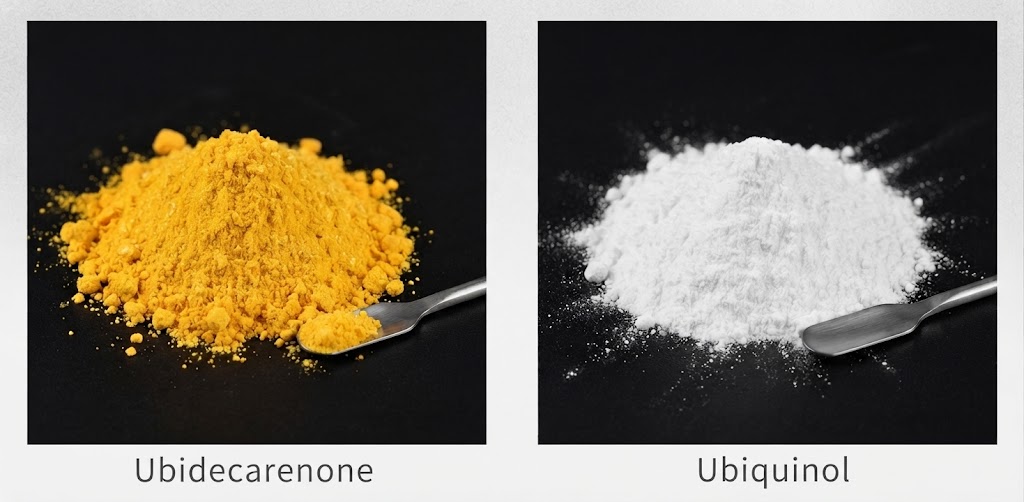
- Appearance & Physical State: Characterized by its distinct, vibrant golden-yellow crystalline powder form.
- Biological Mechanism: Once ingested, Ubidecarenone must be reduced into ubiquinol inside the body via enzymatic processes before it can be fully utilized by cells and tissues.
- Stability & Processing: Exhibits robust chemical stability under standard storage and manufacturing conditions, versatile for standard hard capsules, tablets, and softgels.
- Market Position: Highly cost-effective, offering an exceptional price-to-performance ratio for mass-market formulations.
2. Reduced Coenzyme Q10 (Ubiquinol)
Ubiquinol is the active, electron-rich, antioxidant form of CoQ10. In a healthy human body, the majority of circulating CoQ10 naturally exists in this reduced state.
- Appearance & Physical State: Characterized by a whitish to off-white fine powder form.
- Biological Mechanism: Because it is already in its reduced, bioactive state, Ubiquinol does not require enzymatic conversion in the digestive tract. It is directly absorbed.
- Bioavailability Advantage: Clinical studies demonstrate significantly higher bioavailability than traditional Ubidecarenone—beneficial for aging consumers or those with lower metabolic conversion efficiency.
- Sensitivity & Formulation: Chemically sensitive to oxygen and light, requiring advanced microencapsulation or specialized softgel/liquid manufacturing technologies.
- Market Position: Positioned as a premium, high-end ingredient targeted at advanced anti-aging and elite sports nutrition.
3. Direct Comparison: Ubiquinone vs. Ubiquinol
| Feature / Parameter | Oxidized CoQ10 (Ubidecarenone) | Reduced CoQ10 (Ubiquinol) |
|---|---|---|
| Chemical Form | Ubiquinone (Oxidized) | Ubiquinol (Reduced / Active) |
| Color & Appearance | Golden-yellow crystalline powder | Whitish / off-white fine powder |
| Metabolic Pathway | Requires enzymatic conversion in the body | Directly absorbed without conversion |
| Bioavailability | Standard absorption profile | Enhanced absorption (ideal for older adults) |
| Stability | High stability under normal conditions | Sensitive to oxygen/light; requires protective tech |
| Commercial Positioning | Mainstream, cost-effective, high volume | Premium tier, high margin, advanced efficacy |
4. Formulation & Market Applications (Ubiquinone vs. Ubiquinol)
When to Choose Ubidecarenone (Oxidized):
- Mass-Market Wellness: Perfect for daily multivitamins, standard energy boosters, and entry-to-mid tier cardiovascular supplements.
- Cost-Sensitive Projects: Allows brands to offer competitive retail pricing while maintaining standard efficacy.
- Broad Manufacturing Compatibility: Easier to blend and encapsulate in standard facility setups without complex anti-oxidation barriers.
When to Choose Ubiquinol (Reduced):
- Targeted Anti-Aging & Longevity Lines: Appeals to consumers seeking cutting-edge cellular defense and mitochondrial health.
- Senior-Focused Formulations: Ideal for older demographics whose natural conversion ability declines with age.
- Premium Softgel Matrices: Often paired with carrier oils (such as MCT oil or d-alpha-tocopherol) to maximize absorption.
Partner with Promaxbio for Premium CoQ10 Raw Materials
At Promaxbio, we supply both pharmaceutical and dietary supplement-grade Oxidized CoQ10 (Ubidecarenone) and Reduced CoQ10 (Ubiquinol) backed by comprehensive Certificate of Analysis (COA) documentation, HPLC assay verification, and strict cGMP quality standards.
Contact our sales and technical team today to request product specifications, quotation details, or trial sample quantities for your next product launch.
Scientific References
- Mantle D, Dybring A. Bioavailability of Coenzyme Q10: An Overview of the Absorption Process and Subsequent Metabolism. Antioxidants. 2020;9(5):386.
https://pmc.ncbi.nlm.nih.gov/articles/PMC7278738/ - Zhang Y, et al. Ubiquinol Is Superior to Ubiquinone to Enhance Coenzyme Q10 Status in Older Men. Journal of the American College of Nutrition. 2018.
https://pubmed.ncbi.nlm.nih.gov/30302465/ - Comparison Study of Plasma Coenzyme Q10 Levels in Healthy Subjects Supplemented with Ubiquinol versus Ubiquinone. Clinical Pharmacology in Drug Development.
https://pubmed.ncbi.nlm.nih.gov/27128225/ - Hosoe K, et al. Study on Safety and Bioavailability of Ubiquinol (Kaneka QH) after Single and 4-week Multiple Oral Administration to Healthy Volunteers. Regulatory Toxicology and Pharmacology. 2007;47(1):19–28.
https://pubmed.ncbi.nlm.nih.gov/16919858/ - Coenzyme Q10 Metabolism: A Review of Unresolved Issues.
https://pmc.ncbi.nlm.nih.gov/articles/PMC9916783/
These publications provide scientific background on the redox forms of CoQ10, comparative bioavailability, human supplementation studies, and factors affecting absorption. Results may vary depending on the formulation, carrier oils, product stability, and study population.