

Dihydromyricetin (DHM) Formulation Guide: Solubility & R&D

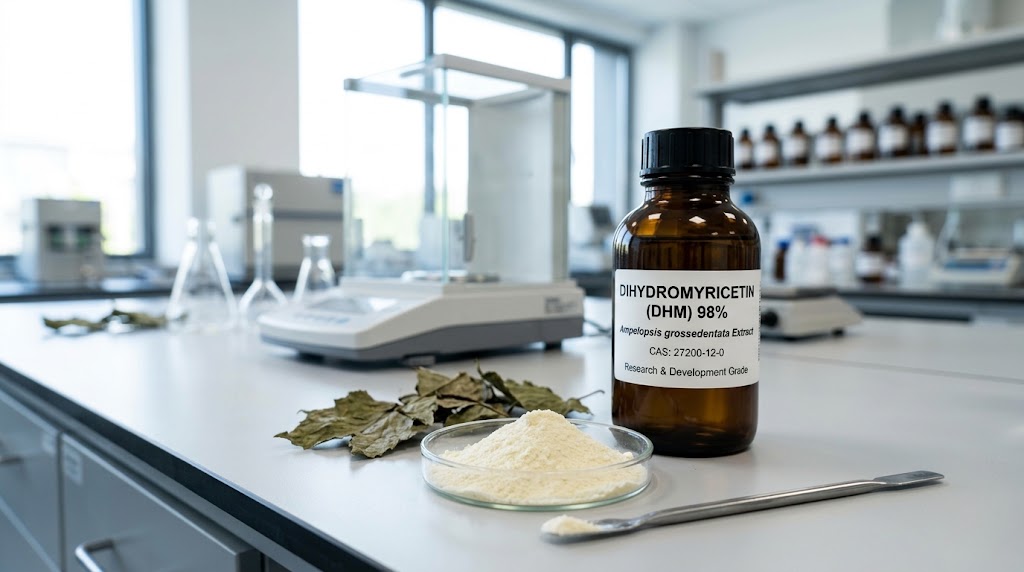
Dihydromyricetin (DHM, also known as Ampelopsin, CAS No. 27200-12-0) has evolved from a traditional botanical flavonoid into a cornerstone functional ingredient for modern hepatoprotective, alcohol-recovery, and metabolic health formulations. Primarily extracted from the tender stems and leaves of Ampelopsis grossedentata (commonly known as Vine Tea or Teng Cha in Traditional Chinese Medicine), high-purity Dihydromyricetin 98% acts as a potent regulator of hepatic enzyme pathways and central nervous system receptor plasticity.
Despite its compelling clinical profile, formulating with Dihydromyricetin presents distinct physicochemical hurdles. As a polyhydroxylated flavanonol (C15H12O8), standard crystalline DHM exhibits low aqueous solubility, limited gastrointestinal permeability, and high sensitivity to alkaline pH and transition metal ions. Below, we answer seven critical formulation, delivery, and sourcing questions for nutraceutical R&D and product development teams.
1. Why Does Standard Dihydromyricetin Have Low Bioavailability, and How Can Formulators Overcome It?
Unmodified Dihydromyricetin 98% is classified as a BCS (Biopharmaceutics Classification System) Class IV compound, characterized by both low aqueous solubility (~0.2 mg/mL at 25°C) and poor intestinal mucosal permeability. In pharmacokinetic models, absolute oral bioavailability of raw crystalline DHM is typically restricted to 4.0% to 5.0%, as the molecule undergoes rapid glucuronidation, sulfation, and methylation in the gastrointestinal tract and liver.
To maximize systemic absorption and reduce the required clinical dose per serving, advanced R&D teams utilize four proven delivery technologies:
- Cyclodextrin Inclusion Complexes: Encapsulating DHM within the hydrophobic cavity of hydroxypropyl-β-cyclodextrin (HP-β-CD) or γ-cyclodextrin increases apparent water solubility by more than 100-fold, allowing rapid dissolution in gastric fluids and clear functional beverages.
- Phytosome & Phospholipid Complexes: Binding Dihydromyricetin to sunflower lecithin (phosphatidylcholine) via hydrogen bonding creates an amphiphilic complex that integrates seamlessly into enterocyte cell membranes, boosting oral bioavailability by 3- to 5-fold.
- Amorphous Solid Dispersions (ASD): Co-processing DHM with hydrophilic polymeric carriers such as PVP K30 or HPMC prevents crystal lattice re-aggregation in the gut lumen, maintaining a supersaturated concentration gradient across the intestinal epithelium.
- Metabolic Bio-Enhancers: Co-formulating with standardized black pepper extract (Piperine) or gingerols transiently inhibits intestinal glucuronidation (UGT enzymes) and P-glycoprotein efflux pumps, extending the plasma half-life of active free DHM.
2. How Do You Prevent Dihydromyricetin From Oxidizing and Discoloring in Functional Beverages and Shots?
One of the most frequent manufacturing failures in liquid recovery shots, RTD (Ready-to-Drink) teas, and effervescent tablets is color shift and precipitate formation. The pyrogallol-type B-ring (three adjacent hydroxyl groups at the C-3′, C-4′, and C-5′ positions) makes Dihydromyricetin highly reactive to dissolved oxygen, thermal processing, and pH fluctuations.
In neutral or slightly alkaline environments (pH > 6.0), DHM undergoes rapid deprotonation and oxidative polymerization, turning the solution from pale yellow to dark brown or reddish-amber while degrading into oxidized quinones and myricetin.
To engineer a shelf-stable liquid or effervescent formula, implement these strict formulation controls:
- Maintain an Acidic pH Buffer (pH 3.2 to 4.5): Protonation of the phenolic hydroxyl groups is essential for chemical stability. Buffer liquid formulations using a citric acid / sodium citrate or malic acid system below pH 4.5, where DHM remains chemically intact through pasteurization and ambient storage.
- Chelate Trace Metal Ions: Trace levels of iron (Fe3+/Fe2+) and copper (Cu2+) present in municipal water or botanical extracts form dark-colored coordination complexes with DHM and catalyze auto-oxidation. Always include food-grade chelators such as sodium hexametaphosphate, trisodium citrate, or calcium disodium EDTA.
- Synergistic Antioxidant Shielding: Pair DHM with L-ascorbic acid (Vitamin C) or erythorbic acid at a 1:2 to 1:5 ratio. Ascorbic acid exhibits a lower redox potential, reducing oxidized DHM intermediates back to their native flavanonol state.
3. Botanical Source Comparison: Ampelopsis grossedentata (Teng Cha) vs. Hovenia dulcis (Zhi Ju Zi)
Both Ampelopsis grossedentata and Hovenia dulcis (Japanese Raisin Tree, known as Zhi Ju Zi) are marketed globally as sources of Dihydromyricetin. However, their phytochemical profiles, extraction economics, and commercial purity grades differ substantially.
| Technical Parameter | Ampelopsis grossedentata (Teng Cha) | Hovenia dulcis (Zhi Ju Zi) |
|---|---|---|
| Plant Part Used | Young leaves and tender stems | Seeds and fleshy fruit peduncles |
| Natural DHM Content | 25% to 40% (by dry weight) | 0.5% to 2.5% (by dry weight) |
| Standard Commercial Specs | 50%, 80%, 90%, 98% DHM (HPLC) | 5:1, 10:1, 5% to 20% DHM / Flavonoids |
| Extraction Solvent | Purified Water / Food-Grade Ethanol | Water / Hydro-alcoholic solvent |
| Primary Application | High-potency capsules, shots, APIs | Full-spectrum botanical blends, teas |
Because Ampelopsis grossedentata naturally accumulates up to 40% Dihydromyricetin in its young foliage, manufacturers can isolate 98% pure crystalline DHM through clean aqueous crystallization without harsh organic solvents. Conversely, Hovenia dulcis contains a broad matrix of minor flavonoids (including quercetin, hovenitins, and saponins) with much lower intrinsic DHM levels, making it suitable for low-percentage full-spectrum extracts rather than high-purity 98% single-compound standardization.
4. How Does Dihydromyricetin Work Biochemically? (Alcohol Metabolism, GABA-A Receptors, and AMPK)
Modern clinical literature demonstrates that Dihydromyricetin operates through a dual peripheral-and-central mechanism, extending its utility far beyond simple antioxidant activity:
- Accelerated Ethanol & Acetaldehyde Clearance: In hepatocytes, DHM upregulates the expression and enzymatic activity of both Alcohol Dehydrogenase (ADH) and Acetaldehyde Dehydrogenase 2 (ALDH2). By accelerating the conversion of toxic acetaldehyde into harmless acetate, it prevents mitochondrial oxidative stress and lipid peroxidation inside liver cells.
- GABAA Receptor Modulation (“Hangxiety” Relief): Acute alcohol intake potentiates inhibitory GABAA receptors while suppressing excitatory glutamate receptors; as blood alcohol drops, receptor plastic rebound triggers tremors, sleep disruption, and rebound anxiety. DHM binds competitively to the benzodiazepine site on GABAA receptors, preventing alcohol-induced receptor internalization and restoring baseline neurochemical equilibrium without sedative side effects.
- AMPK & SIRT3 Activation for Metabolic Liver Health: In non-alcoholic metabolic applications, Dihydromyricetin activates the AMPK / Nrf2 / SIRT3 signaling cascade, suppressing de novo lipogenesis, enhancing hepatic beta-oxidation of fatty acids, and inhibiting the NLRP3 inflammasome.
5. How Do You Formulate High-Efficacy Synergistic Stacks With Dihydromyricetin?
To differentiate finished supplements in competitive retail channels, formulators combine Dihydromyricetin with complementary cofactors targeting multiple phases of cellular detoxification:
- The Acute Recovery & Acetaldehyde Stack: Combine Dihydromyricetin 98% (300 mg to 600 mg) + N-Acetyl-L-Cysteine / NAC (200 mg) or Reduced L-Glutathione (100 mg) + Prickly Pear Extract (Opuntia ficus-indica) + Vitamin B1 (Thiamine) & B6 (P-5-P). While DHM drives ALDH2 enzymatic speed, NAC and glutathione replenish the hepatic thiol pool required to neutralize reactive oxygen species.
- The Comprehensive Hepatoprotective Stack: Combine Dihydromyricetin (250 mg) + Milk Thistle Extract (80% Silymarin / 30% Silybin) + Artichoke Leaf Extract (5% Cynarin) + Choline Bitartrate. Silymarin stabilizes the outer hepatocyte cell membrane against toxin entry, while DHM regulates intracellular lipid metabolism and mitochondrial biogenesis.
- The Uric Acid & Metabolic Balance Stack: Combine Dihydromyricetin (300 mg) + Tart Cherry Extract + Luteolin + Quercetin. Both DHM and luteolin act as natural xanthine oxidase inhibitors, supporting healthy serum uric acid levels and joint comfort.
6. How Do You Mask the Taste of Dihydromyricetin in Chewable Tablets and Gummies?
Pure Dihydromyricetin exhibits a distinct sensory profile characteristic of vine tea: an initial mild astringency and slight bitterness followed by a lingering, refreshing sweet aftertaste (known as Hui Gan). In high-dose chewable tablets, orally disintegrating strips, or gummies (where a 300 mg dose represents a substantial portion of the matrix), the polyphenolic astringency can dry the palate.
Formulators neutralize this mouthfeel using three practical techniques:
- Cyclodextrin Molecular Masking: Using water-soluble HP-β-CD complexed DHM physically shields the phenolic hydroxyl groups from interacting with bitter taste receptors (TAS2Rs) on the tongue.
- Organic Acid & Citrus Flavor Pairing: Because DHM has a naturally sweet finish, pairing it with sharp organic acids (citric acid, tartaric acid) and high-impact citrus, yuzu, peach, or berry flavor profiles blends seamlessly with its botanical notes, while also stabilizing its pH.
- Polysaccharide Mouthfeel Modifiers: Adding 0.2% to 0.5% gum arabic or pectin in liquid and chewable formats coats salivary proteins, preventing the tannin-like astringent binding sensation.
7. Quality Control: How to Audit Dihydromyricetin COAs (HPLC vs. UV and Stereochemical Purity)
When qualifying a bulk raw material supplier for Dihydromyricetin, procurement teams must distinguish between spectrophotometric (UV) testing and chromatographic (HPLC) quantification:
- HPLC vs. UV Assay Discrepancies: UV spectrophotometry measures total flavonoid absorbance at ~290 nm, which includes oxidized degradation products (such as myricetin) and minor flavanones. Always specify ≥98.0% Dihydromyricetin by HPLC on an anhydrous basis to ensure true active monomer potency.
- Myricetin Impurity Control: During aggressive thermal extraction or improper drying, DHM loses two hydrogen atoms at the C2-C3 bond and oxidizes into yellow-green myricetin (CAS No. 529-44-2). Premium 98% DHM should be an off-white to white crystalline powder with myricetin impurity strictly controlled below 1.0% to 1.5%.
- Chiral Integrity: Naturally occurring bioactive DHM in Ampelopsis grossedentata exists predominantly as the (2R,3R)-(+)-dihydromyricetin enantiomer. Gentle low-temperature aqueous extraction preserves this natural stereochemical configuration without thermal racemization.
Frequently Asked Questions (FAQ)
What is the difference between Dihydromyricetin 98% and Water-Soluble Dihydromyricetin?
Dihydromyricetin 98% is the pure crystalline flavanonol compound ideal for hard-shell capsules, tablets, and softgel suspensions. Water-Soluble Dihydromyricetin (typically standardized to 10% to 30% active DHM) is a microencapsulated or cyclodextrin-inclusion complex engineered specifically to dissolve completely into clear beverages, instant drink powders, and liquid drops without sedimentation.
Does Dihydromyricetin contain caffeine or stimulants?
No. Although Ampelopsis grossedentata is colloquially called “Vine Tea,” it does not belong to the Camellia sinensis family and is 100% caffeine-free. This makes Dihydromyricetin safe for evening or nighttime recovery formulations without disrupting sleep architecture.
What are the recommended storage conditions for bulk Dihydromyricetin powder?
Store bulk Dihydromyricetin in tightly sealed, light-resistant aluminum foil bags inside fiber drums in a cool, dry warehouse (below 25°C and Relative Humidity under 60%). Avoid contact with alkaline substances, strong oxidizers, and iron containers during dispensing and blending.
Source High-Purity Dihydromyricetin Direct From a Trusted B2B Botanical Manufacturer
Whether your product pipeline calls for standard Dihydromyricetin 98% (HPLC) for capsule and tablet manufacturing, custom Water-Soluble DHM for clear functional beverages, or standardized Hovenia dulcis extracts, consistent raw material quality is critical to your brand’s clinical performance. We support international nutraceutical brands and contract manufacturers with flexible MOQs, comprehensive third-party analytical documentation (COA, HPLC chromatograms, heavy metals, and pesticide residue reports), and custom China ingredient sourcing. Contact our technical sales team today to request a free R&D evaluation sample or bulk quotation.
References & Authoritative Literature
- Shen, Y., Lindemeyer, A. K., Gonzalez, C., Shao, X. M., Spigelman, I., Olsen, R. W., & Liang, J. (2012). Dihydromyricetin as a novel anti-alcohol intoxication medication. The Journal of Neuroscience, 32(1), 390-401.
- Chen, S., Zhao, X., Wan, J., Ran, L., Qin, Y., Wang, X., Gao, Y., Gong, F., Yang, J., & Zhu, M. (2015). Dihydromyricetin improves glucose and lipid metabolism and exerts anti-inflammatory effects in nonalcoholic fatty liver disease: A randomized controlled trial. Pharmacological Research, 99, 74-81.
- Liu, D., Mao, Y., Ding, L., & Zeng, X. A. (2019). Dihydromyricetin: A review on identification and quantification methods, biological activities, chemical stability, metabolism and approaches to enhance its bioavailability. Trends in Food Science & Technology, 91, 586-597.