
Beauty-from-Within Ingredients in 2026: Astaxanthin, Glutathione and More


Table of Contents
Beauty from within ingredients are attracting growing interest from dietary supplement brands and functional ingredient developers in 2026. These ingredients are increasingly explored for skin hydration, antioxidant nutrition, skin barrier support, and healthy aging formulations.
Rather than focusing exclusively on topical skincare, this category explores how nutritional ingredients may contribute to normal skin physiology, antioxidant defense, and overall wellness.
Among the ingredients frequently considered for beauty-oriented supplement formulations are astaxanthin, glutathione, collagen peptides, hyaluronic acid, and ceramides.
Each ingredient has different characteristics, research evidence, formulation requirements, and regulatory considerations.
For supplement manufacturers and ingredient buyers, understanding these differences is essential for developing responsible, high-quality products.
1. What Is Beauty-from-Within?
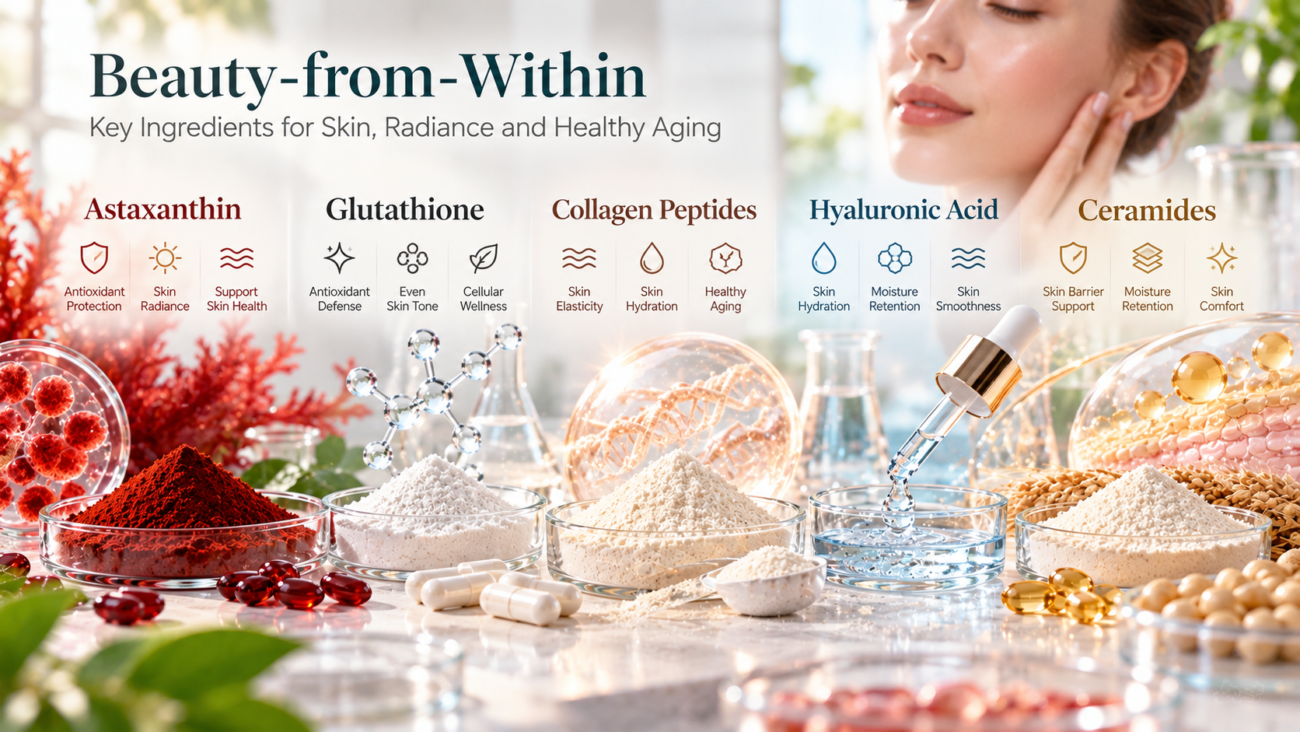
Beauty-from-within refers to ingestible products developed around skin-related nutritional and wellness concepts.
Common product positioning includes:
- Skin hydration
- Skin elasticity
- Antioxidant nutrition
- Skin barrier support
- Healthy aging
- Hair and nail nutrition
These concepts should not be confused with guaranteed clinical outcomes.
The effectiveness of an ingestible beauty product depends on its ingredients, dosage, formulation, study evidence, and the characteristics of the target population.
2. Astaxanthin: A Carotenoid for Antioxidant Formulations
Astaxanthin is a naturally occurring carotenoid pigment found in certain microorganisms and marine organisms.
A major commercial source is the microalga Haematococcus pluvialis.
CAS Number: 472-61-7
Molecular Formula: C40H52O4
Astaxanthin has attracted research interest because of its antioxidant properties and potential relevance to skin physiology.
Research and Applications
Human studies have investigated astaxanthin in relation to:
- Skin hydration
- Skin elasticity
- Skin texture
- Responses to ultraviolet-related oxidative stress
Some studies and reviews report promising findings, but study sizes, formulations, and methods vary.
Astaxanthin should not be described as a replacement for sunscreen or as a proven treatment for skin damage.
Sourcing Considerations
Buyers should verify:
- Astaxanthin content and analytical method
- Natural or synthetic origin
- Source organism
- Esterified or free astaxanthin content
- Carrier oils and other formulation components
- Oxidative stability
- Packaging and storage conditions
Astaxanthin is lipophilic, making delivery systems and formulation stability especially important.
3. Glutathione: An Important Cellular Antioxidant
Glutathione is a naturally occurring tripeptide composed of glutamate, cysteine, and glycine.
It plays an important role in cellular redox balance and antioxidant defense.
Common Ingredient: Reduced L-Glutathione
CAS Number: 70-18-8
Molecular Formula: C10H17N3O6S
Why Is Glutathione Used in Beauty Supplements?
Glutathione has attracted interest in products positioned around antioxidant nutrition and skin appearance.
Some small human studies have investigated oral glutathione and skin pigmentation-related outcomes.
However, the evidence remains limited, and findings do not establish reliable skin-lightening results for all populations or products.
Glutathione should not be marketed with unsupported claims about permanent skin whitening or treatment of pigmentation disorders.
Formulation Considerations
Reduced glutathione may be sensitive to oxidation.
Manufacturers should evaluate:
- Ingredient purity
- Reduced versus oxidized forms
- Stability during processing
- Moisture exposure
- Compatibility with other ingredients
- Finished-product shelf life
For B2B buyers, the exact chemical form and assay method should be clearly identified.
4. Collagen Peptides: A Major Ingredient in Beauty Nutrition
Collagen peptides are produced through the hydrolysis of collagen-containing raw materials.
Commercial sources may include bovine, porcine, and marine collagen.
Formulation Interest
Collagen peptides are widely used in products positioned around:
- Skin hydration
- Skin elasticity
- Skin appearance
- Joint and general wellness
Some randomized clinical trials and systematic reviews have reported improvements in selected skin measurements following oral collagen peptide supplementation.
However, study quality and potential industry funding biases must be considered when interpreting the evidence.
Important Procurement Factors
Collagen peptides are not a single uniform ingredient.
Buyers should examine:
- Animal source
- Molecular weight distribution
- Degree of hydrolysis
- Protein content
- Amino acid profile
- Allergen information
- Sensory properties
- Traceability and contaminant testing
Marine collagen products may require additional attention to fish allergen declarations.
5. Hyaluronic Acid: A Hydration-Focused Ingredient
Hyaluronic acid is a glycosaminoglycan naturally present in human connective tissues, including skin.
Commercial oral supplement ingredients often use sodium hyaluronate.
Formulation Applications
Oral hyaluronic acid has been investigated for skin hydration and other skin-related outcomes.
Some controlled human studies report favorable results, but the clinical evidence remains product- and dose-specific.
Sourcing Considerations
Important parameters include:
- Chemical identity
- Molecular weight
- Purity
- Microbiological quality
- Fermentation origin
- Residual processing impurities
- Stability and storage conditions
Molecular weight can be particularly relevant to ingredient characterization and formulation behavior.
6. Ceramides: Nutritional Ingredients for Skin Barrier Research
Ceramides are lipids naturally present in the skin barrier.
In oral beauty supplements, commercial ingredients may include plant-derived glucosylceramides or other defined sphingolipid preparations.
These should not be assumed to be chemically identical to cosmetic-grade Ceramide NP.
Potential Applications
Oral ceramide preparations have been studied in relation to:
- Skin hydration
- Transepidermal water loss
- Skin barrier-related measurements
Some human trials have reported improvements in selected outcomes.
However, results depend on the specific ingredient preparation, dosage, and study design.
Sourcing Considerations
Buyers should verify:
- Plant or other source material
- Exact lipid composition
- Glucosylceramide or other marker content
- Extraction method
- Analytical specifications
- Allergen considerations
- Regulatory suitability
A generic claim such as “contains ceramides” is not sufficient to establish equivalence between different raw materials.
7. Comparing Five Beauty-from-Within Ingredients
| Ingredient | Main formulation interest | Important sourcing consideration |
|---|---|---|
| Astaxanthin | Antioxidant and skin-related research | Source, assay, oxidation stability |
| Glutathione | Cellular antioxidant nutrition | Reduced form, purity, stability |
| Collagen peptides | Skin hydration and elasticity research | Source, molecular weight, allergens |
| Hyaluronic acid | Skin hydration research | Molecular weight, purity, identity |
| Oral ceramides | Skin barrier and hydration research | Specific lipid composition and assay |
These ingredients may support different product concepts, but they are not interchangeable.
8. Formulation Opportunities for Supplement Brands
Beauty-from-within ingredients can be used in several types of products.
Antioxidant Beauty Capsules
Astaxanthin and other compatible antioxidants may be considered for formulations focused on antioxidant nutrition.
Skin Hydration Formulations
Hyaluronic acid and certain oral ceramide preparations may be evaluated for hydration-oriented product concepts.
Collagen-Based Beauty Powders
Collagen peptides can be incorporated into powdered supplement formats, subject to taste, solubility, and stability requirements.
Multi-Ingredient Beauty Supplements
Brands may explore combinations of collagen peptides, hyaluronic acid, astaxanthin, and other ingredients.
However, the presence of multiple ingredients does not automatically establish additive or synergistic benefits.
Finished-product claims should be supported by suitable evidence.
9. Quality Control for Beauty Supplement Ingredients
Ingredient quality is especially important for formulations intended for repeat commercial production.
Buyers should evaluate the following:
Identity
Confirm the correct ingredient form and source.
Assay
Request an appropriate validated analytical method.
Impurities
Review relevant process impurities and degradation products.
Contaminants
Evaluate heavy metals, microbiological quality, and residual solvents where applicable.
Stability
Confirm suitable packaging, storage conditions, and shelf-life documentation.
Regulatory Compliance
Check ingredient eligibility, permitted uses, labeling requirements, and applicable claims regulations in the intended market.
Batch Consistency
Request batch-specific Certificates of Analysis and reliable manufacturing traceability.
10. Regulatory and Marketing Considerations
Beauty-from-within products are subject to the regulatory framework applicable to their ingredients and finished-product categories.
In the United States, dietary supplement claims must comply with applicable FDA requirements, while advertising claims are also subject to FTC standards.
In the European Union, nutrition and health claims are subject to specific authorization requirements.
Brands should avoid unsupported claims such as:
- Reverses skin aging
- Permanently whitens skin
- Repairs all skin damage
- Eliminates wrinkles
- Guarantees increased collagen production
Scientific findings about an ingredient do not automatically authorize equivalent claims for a commercial finished product.
11. Frequently Asked Questions
Which ingredients are commonly used in beauty-from-within supplements?
Astaxanthin, glutathione, collagen peptides, hyaluronic acid, and certain oral ceramide preparations are among the ingredients used in this category.
Is oral glutathione proven to whiten skin?
Current evidence is insufficient to establish consistent or permanent skin-lightening benefits.
Is astaxanthin water-soluble?
Astaxanthin is generally lipophilic. Its behavior in a finished formulation depends on the supplied ingredient grade and delivery system.
Are oral ceramides the same as cosmetic Ceramide NP?
No. Oral ceramide preparations may contain different sphingolipid compounds, including glucosylceramides.
Can beauty supplement ingredients be combined?
Potentially, but compatibility, stability, safety, regulatory status, and supporting evidence must be evaluated.
What documents should buyers request?
A specification sheet, Certificate of Analysis, safety data sheet where applicable, relevant testing results, and regulatory documentation.
Conclusion
Beauty-from-within offers opportunities for supplement brands interested in skin-related nutritional products.
Astaxanthin, glutathione, collagen peptides, hyaluronic acid, and oral ceramide ingredients represent different approaches to product development.
For manufacturers and ingredient buyers, successful formulation requires more than selecting popular ingredients.
Scientific evidence, ingredient identity, analytical quality, stability, and regulatory suitability should guide sourcing decisions.
Beauty Supplement Ingredient Sourcing with ProMaxBio
ProMaxBio supports professional sourcing of botanical extracts, functional ingredients, and raw materials for dietary supplement development.
We work with ingredient buyers and manufacturers on raw material specifications, quality documentation, and bulk sourcing inquiries.
For information about ingredient availability, specifications, samples, or quotations, please contact us.
Email: info@promaxbio.com
WhatsApp / WeChat: +86 173 9295 7286
Website: https://promaxbio.com
Disclaimer: This article is intended for B2B educational purposes and does not constitute medical or regulatory advice. Ingredient applications and commercial claims must be evaluated for the relevant market.
References and Further Reading
- U.S. Food and Drug Administration. Dietary Supplements. https://www.fda.gov/food/dietary-supplements
- U.S. Federal Trade Commission. Health Products Compliance Guidance. https://www.ftc.gov/business-guidance/resources/health-products-compliance-guidance
- European Commission. Nutrition and Health Claims. https://food.ec.europa.eu/safety/labelling-and-nutrition/nutrition-and-health-claims_en
- NIH Office of Dietary Supplements. Dietary Supplement Fact Sheets. https://ods.od.nih.gov/factsheets/list-all/
- PubMed. Research literature on oral astaxanthin, collagen peptides, glutathione, hyaluronic acid, and ceramide supplementation. https://pubmed.ncbi.nlm.nih.gov/