
Functional Mushrooms in 2026: Lion’s Mane, Reishi and Cordyceps for Supplement Formulations


Functional mushrooms have become an important ingredient category in the dietary supplement industry. From cognitive wellness concepts to general well-being and active lifestyle formulations, mushroom-derived ingredients offer a wide range of product development opportunities.
Among the most recognized varieties are Lion’s Mane, Reishi, and Cordyceps.
However, not all mushroom extracts are equivalent. Differences in fungal species, raw material selection, extraction methods, active compound profiles, and testing procedures can significantly influence ingredient quality.
For supplement brands, manufacturers, and raw material buyers, understanding these differences is essential for responsible product development.
This guide explores three major functional mushrooms, their formulation applications, and the key factors to consider when sourcing mushroom extracts in 2026.
1. Why Functional Mushrooms Matter in Supplement Development
Functional mushrooms contain naturally occurring compounds such as polysaccharides, beta-glucans, triterpenoids, and other secondary metabolites.
Different mushroom species have distinct chemical profiles, making them suitable for different research and formulation concepts.
Common areas of product development include:
- Cognitive wellness
- General immune wellness
- Active lifestyle and exercise nutrition
- Stress and daily wellness formulations
- Healthy aging research
- Multi-ingredient mushroom blends
Although these applications have attracted considerable scientific and commercial interest, the strength of human evidence varies substantially among mushroom species and preparations.
Supplement manufacturers should distinguish traditional use, laboratory research, and clinical evidence when developing product claims.
2. Lion’s Mane Mushroom Extract
Scientific Name: Hericium erinaceus
Common Name: Lion’s Mane Mushroom
Primary Formulation Interest: Cognitive wellness and healthy aging research
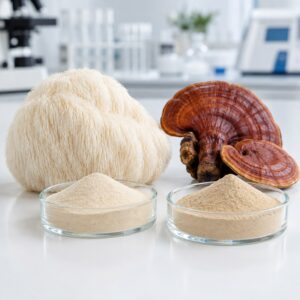
Lion’s Mane is a distinctive edible mushroom recognized by its white, cascading spines.
It has attracted attention for its naturally occurring compounds, including hericenones and erinacines.
Key Compounds
Beta-Glucans
Structural polysaccharides present in fungal cell walls.
Hericenones
Compounds associated primarily with the fruiting body of Lion’s Mane.
Erinacines
A group of compounds studied in certain Lion’s Mane mycelial preparations.
These compounds have been investigated in preclinical research, particularly in relation to neuronal signaling and nerve growth factor-related pathways.
However, results from laboratory studies cannot be directly translated into established cognitive benefits in humans.
Formulation Applications
Lion’s Mane may be considered for:
- Cognitive wellness supplements
- Mushroom complex capsules
- Healthy aging formulations
- Functional beverage powders
- Daily wellness products
Sourcing Considerations
When purchasing Lion’s Mane extract, buyers should verify:
- Botanical or fungal identity
- Fruiting body or mycelium origin
- Extraction method
- Beta-glucan content
- Analytical methods for any claimed hericenones or erinacines
- Microbiological and contaminant specifications
A Lion’s Mane product standardized for beta-glucans should not automatically be assumed to contain a defined level of hericenones or erinacines.
3. Reishi Mushroom Extract
Scientific Name: Ganoderma lucidum species complex; exact species identification should be confirmed
Common Name: Reishi or Lingzhi
Primary Formulation Interest: General wellness and immune-related research
Reishi has a long history of traditional use in East Asia.
Modern research has focused on several classes of naturally occurring compounds, particularly polysaccharides and triterpenoids.
Key Compounds
Beta-Glucans
Fungal polysaccharides of interest in immune-related research.
Ganoderic Acids and Other Triterpenoids
A diverse group of compounds associated with certain Ganoderma species.
Other Polysaccharides
Complex carbohydrates that vary according to species, cultivation, and extraction conditions.
Formulation Applications
Reishi extract may be considered for:
- General wellness supplements
- Mushroom complex formulations
- Immune wellness product concepts
- Botanical and mushroom blends
- Capsules and powdered supplements
What Does the Research Show?
Reishi has been investigated in human clinical studies, but findings remain mixed.
Differences in study populations, extract compositions, dosages, and trial quality make it difficult to establish consistent clinical benefits.
Reishi should not be marketed as a proven treatment for disease or as an ingredient with universally established health outcomes.
Sourcing Considerations
For Reishi extract, buyers should examine:
- Confirmed species identity
- Fruiting body or mycelium source
- Beta-glucan specification
- Triterpenoid content and testing method
- Extraction process
- Batch consistency
The term “Reishi” may be used commercially for materials from different Ganoderma species. Accurate scientific identification is therefore important.
4. Cordyceps Mushroom Extract
Common Commercial Species: Cordyceps militaris
Other Recognized Species: Ophiocordyceps sinensis
Primary Formulation Interest: Active lifestyle and general wellness research
Cordyceps is a broad commercial term that can refer to different fungal species.
This distinction matters because species can differ significantly in their chemical composition, cultivation methods, availability, and cost.
Key Compounds
Cordycepin
Also known as 3′-deoxyadenosine, cordycepin is a nucleoside analog investigated in laboratory and preclinical research.
Adenosine
A naturally occurring nucleoside that may be included in analytical profiles.
Polysaccharides and Beta-Glucans
Fungal carbohydrates that contribute to the broader chemical composition of the material.
Formulation Applications
Cordyceps extracts may be considered for:
- Active lifestyle supplements
- Mushroom blends
- General wellness products
- Sports nutrition research concepts
- Capsules and powder formulations
Sourcing Considerations
Buyers should confirm:
- Exact fungal species
- Cultivation method
- Fruiting body or mycelium origin
- Cordycepin assay, where applicable
- Adenosine and other relevant markers
- Beta-glucan testing
- Heavy metal and microbiological specifications
A Cordyceps militaris extract should not be presented as equivalent to Ophiocordyceps sinensis without clear scientific and commercial justification.
5. Lion’s Mane vs. Reishi vs. Cordyceps
| Feature | Lion’s Mane | Reishi | Cordyceps |
|---|---|---|---|
| Main species | Hericium erinaceus | Ganoderma species | Commonly C. militaris |
| Formulation interest | Cognitive wellness | General and immune wellness | Active lifestyle |
| Notable compounds | Beta-glucans, hericenones, erinacines | Beta-glucans, triterpenoids | Cordycepin, adenosine, beta-glucans |
| Common dosage forms | Capsules, powders | Capsules, powders | Capsules, powders |
| Important sourcing factor | Fruiting body vs. mycelium | Species and triterpenoid profile | Species and cordycepin assay |
| Main quality concern | Marker identity and testing | Accurate standardization | Species authenticity and assay |
These differences help explain why a single specification cannot adequately describe every functional mushroom extract.
6. Understanding Beta-Glucans in Mushroom Extracts
Beta-glucans are among the most important quality markers used in the functional mushroom ingredient industry.
They are polysaccharides containing glucose units linked through beta-glycosidic bonds.
Certain fungal beta-glucans contain beta-1,3 and beta-1,6 linkages.
However, mushroom products may also contain other carbohydrates, including alpha-glucans and starch.
Total Polysaccharides vs. Beta-Glucans
These terms are not interchangeable.
Total polysaccharides refers to a broader group of carbohydrate compounds.
Beta-glucans refers to a more specific group of polysaccharides.
For example, a mushroom extract described as containing 30% total polysaccharides does not necessarily contain 30% beta-glucans.
This is an important distinction when comparing supplier quotations.
Why Testing Methods Matter
Different analytical methods may produce different results.
Some traditional colorimetric methods estimate total polysaccharide content but do not specifically quantify beta-glucans.
More targeted enzymatic methods are available for fungal beta-glucan determination.
Buyers should request the actual analytical method used rather than relying only on a percentage listed in a product catalog.
7. Fruiting Body vs. Mycelium: What Is the Difference?
One of the most common questions in mushroom ingredient sourcing concerns the distinction between fruiting bodies and mycelium.
Fruiting Body
The fruiting body is the visible reproductive structure of a mushroom.
It may contain various polysaccharides and secondary metabolites depending on the species.
Mycelium
Mycelium consists of the fungal network of filamentous structures.
Mycelial material may be cultivated through liquid fermentation or on solid substrates.
Mycelium Grown on Grain
Some commercial materials contain mycelium cultivated on cereal grains.
Depending on harvesting and processing methods, the finished material may contain residual grain starch.
This can influence carbohydrate composition and analytical results.
Neither fruiting body nor mycelium should automatically be considered superior in every application.
The correct choice depends on the species, target compounds, manufacturing process, and quality specifications.
For buyers, the most important requirement is accurate identification and transparent disclosure of the material being supplied.
8. Extraction Methods and Their Influence on Quality
Extraction conditions can influence the chemical composition of mushroom ingredients.
Hot Water Extraction
Hot water extraction is commonly used to obtain water-soluble polysaccharide fractions.
It may be relevant when beta-glucans and other water-extractable compounds are the primary formulation interest.
Ethanol Extraction
Ethanol extraction may be used to obtain certain less-polar compounds, including some triterpenoids.
This can be particularly relevant for selected Reishi extract specifications.
Dual Extraction
Dual extraction combines aqueous and solvent-based processing steps to target a broader range of constituents.
However, the term “dual extract” does not guarantee a particular chemical profile or superior biological activity.
Extraction Ratio
Extract ratios such as 10:1 or 20:1 may describe the relationship between starting material and finished extract under a supplier’s defined process.
They do not establish the concentration of a specific active compound.
For procurement purposes, an extract ratio should be supported by clear manufacturing definitions and appropriate analytical specifications.
9. How to Evaluate Mushroom Extract Specifications
Before purchasing bulk mushroom extracts, ingredient buyers should request a detailed specification sheet.
Identity
Confirm the scientific species name and relevant plant or fungal material.
Active Markers
Determine whether the extract is standardized for beta-glucans, triterpenoids, cordycepin, or another specified compound.
Analytical Method
Review the test method and whether it is suitable for the claimed marker.
Heavy Metals
Evaluate relevant limits and test results for lead, cadmium, arsenic, and mercury.
Microbiological Quality
Review total microbial counts and pathogen-related specifications appropriate for the intended market.
Residual Solvents
Where solvent extraction is used, assess residual solvent testing.
Moisture and Storage
Check moisture limits, packaging, storage conditions, and shelf-life information.
Batch Traceability
Request a Certificate of Analysis for the specific production batch.
A reliable supplier should be able to explain how the product is identified, processed, tested, and controlled.
10. Formulation Opportunities for Supplement Brands
Functional mushrooms can be incorporated into several types of supplement products.
Single-Ingredient Capsules
These formulations emphasize a clearly identified mushroom species and defined raw material specifications.
Multi-Mushroom Complexes
Formulations may combine Lion’s Mane, Reishi, Cordyceps, and other mushrooms.
However, buyers should confirm the identity and contribution of each component rather than relying solely on the total blend weight.
Mushroom and Botanical Combinations
Mushroom ingredients may be paired with compatible botanical extracts or other functional ingredients.
The formulation should be evaluated for ingredient interactions, stability, and applicable regulatory requirements.
Functional Powders
Mushroom extracts can be used in powdered products, subject to flavor, solubility, dispersibility, and stability requirements.
Bulk Capsule Manufacturing
Mushroom extracts may be suitable for bulk capsule production.
Manufacturers should evaluate powder flow, bulk density, moisture, fill weight, capsule size, and excipient requirements before finalizing production.
11. Frequently Asked Questions
Which mushroom is best for cognitive wellness formulations?
Lion’s Mane is frequently considered for cognitive wellness product concepts, but the human evidence remains limited and formulation-specific.
Is Reishi extract standardized by beta-glucans or triterpenoids?
Both types of markers may be relevant, depending on the product specification and extraction process.
What is the difference between Cordyceps militaris and Ophiocordyceps sinensis?
They are different fungal species with distinct cultivation, chemical, and commercial characteristics.
Does a higher extract ratio mean better quality?
Not necessarily. Extract ratio alone does not establish the concentration of important constituents or overall product quality.
Are total polysaccharides and beta-glucans the same?
No. Beta-glucans are a specific group of polysaccharides, while total polysaccharides represent a broader category.
What should buyers request before ordering mushroom extract?
A specification sheet, batch Certificate of Analysis, identification details, analytical methods, contaminant testing, and relevant regulatory documentation.
Conclusion
Lion’s Mane, Reishi, and Cordyceps offer different opportunities for modern supplement formulation.
Their commercial value depends not only on ingredient recognition but also on accurate species identification, appropriate extraction methods, meaningful analytical specifications, and consistent manufacturing quality.
For supplement brands and ingredient buyers, beta-glucan testing, transparent sourcing, and batch-specific documentation are essential considerations.
Choosing the right mushroom extract requires evaluating both its intended formulation role and the evidence supporting its quality.
Functional Mushroom Ingredient Sourcing with ProMaxBio
ProMaxBio supports professional sourcing of botanical extracts, functional ingredients, and raw materials for dietary supplement manufacturing.
For inquiries about mushroom extract availability, ingredient specifications, samples, and bulk quotations, please contact our team.
Email: info@promaxbio.com
WhatsApp / WeChat: +86 173 9295 7286
Website: https://promaxbio.com
Disclaimer: This article is intended for B2B educational purposes. It does not provide medical advice or establish approval for any specific ingredient, application, or health claim.
References
- McCleary BV, Draga A. Measurement of β-Glucan in Mushrooms and Mycelial Products. Journal of AOAC International. 2016;99(2):364–373.
- Jafari A, et al. The Nutritional Significance of Ganoderma lucidum on Human Health: A GRADE-Assessed Systematic Review and Meta-Analysis of Clinical Trials. Food Science & Nutrition. 2025. https://pubmed.ncbi.nlm.nih.gov/40510787/
- Advances in Enzymatic Measurement of β-Glucan in Mushrooms, Yeast, Algae, and Dietary Supplements. Journal of AOAC International. 2026. https://doi.org/10.1093/jaoacint/qsag041
- Megazyme by Neogen. Beta-Glucan Assay Kit (Yeast and Mushroom): Technical Method Information. https://www.megazyme.com/Beta-Glucan-Assay-Kit-Yeast-Mushroom