

Alpha-GPC vs Citicoline: Key Differences for Supplement Formulators

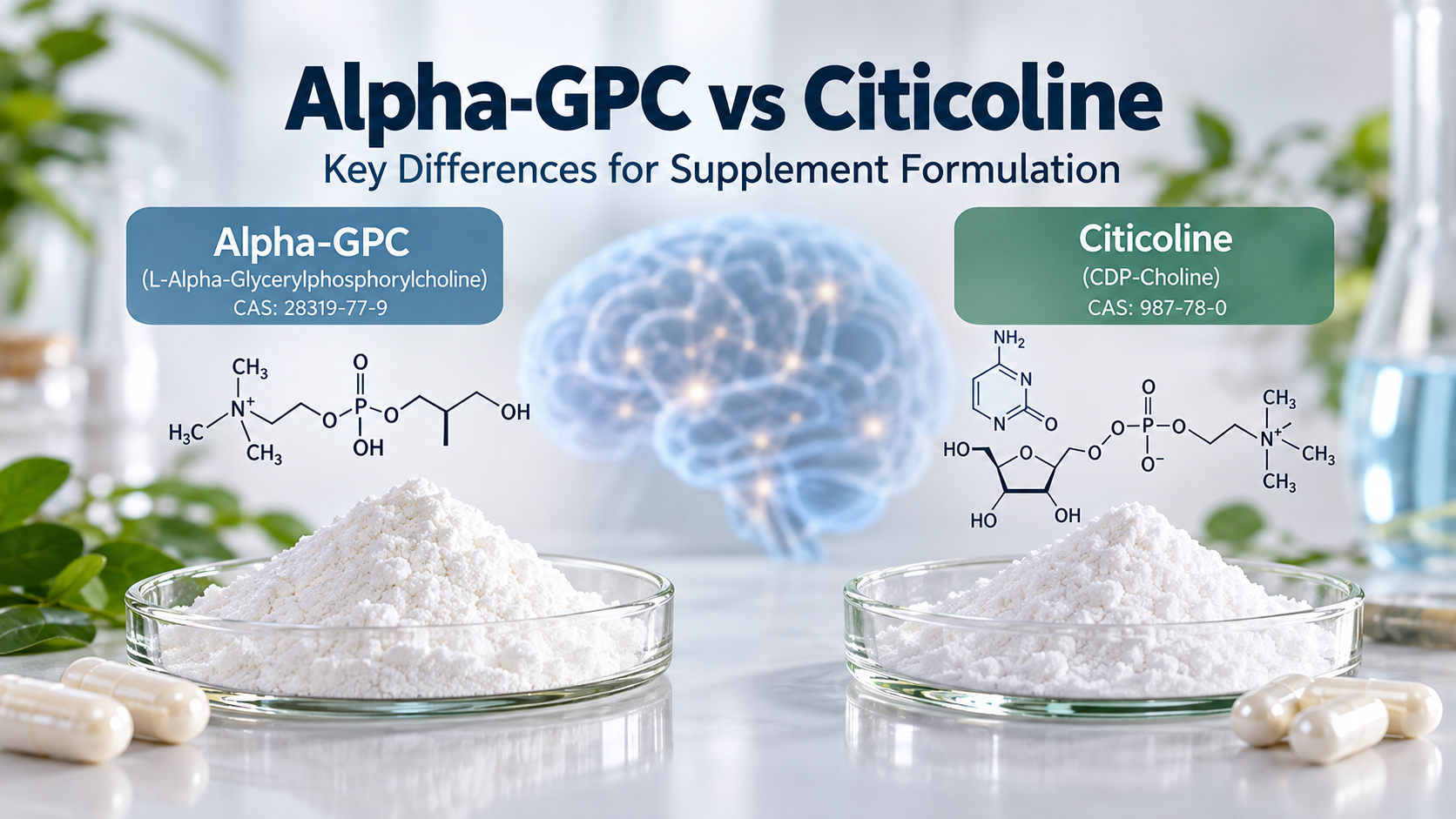
Table of Contents
Alpha-GPC and Citicoline are two widely recognized choline-containing ingredients used in dietary supplements and cognitive health formulations. Although both provide choline, they differ in chemical structure, choline content, physical properties, and formulation considerations.
For supplement manufacturers, ingredient distributors, and product development teams, understanding these differences is important when evaluating raw material specifications, quality documentation, and sourcing options.
This guide compares Alpha-GPC vs Citicoline from a practical B2B formulation and ingredient procurement perspective.
Alpha-GPC vs Citicoline – What Is Alpha-GPC?
Alpha-GPC, also known as Alpha-Glycerylphosphorylcholine or Choline Alfoscerate, is a choline-containing compound associated with phospholipid metabolism.
Key ingredient information:
- Chemical name: L-Alpha-Glycerylphosphorylcholine
- Common name: Alpha-GPC
- CAS Number: 28319-77-9
- Common commercial specifications: 50% and 99%, depending on the product grade
- Appearance: Typically white to off-white powder, depending on the formulation and carrier system
Alpha-GPC is used in certain nutritional supplement formulations where choline delivery is a product development consideration.
One important formulation characteristic is its hygroscopic nature. High-purity Alpha-GPC can absorb moisture from the surrounding environment, which may create challenges during storage, weighing, blending, and encapsulation.
Some commercial Alpha-GPC grades are supplied using carrier materials to improve handling properties. Consequently, formulators should distinguish between the percentage of Alpha-GPC in the supplied material and the amount of choline delivered by the finished formulation.
Alpha-GPC vs Citicoline – What Is Citicoline?
Citicoline, also known as CDP-Choline or Cytidine 5′-Diphosphocholine, is another choline-containing compound used in nutritional and research-related applications.
Key ingredient information:
- Chemical name: Cytidine 5′-Diphosphocholine
- Common name: Citicoline
- CAS Number: 987-78-0 for citicoline free acid
- Common commercial specification: 99%, depending on the chemical form and supplier
- Appearance: Typically white to off-white powder
Citicoline contains both a cytidine-related component and a choline component. This distinguishes its molecular structure from Alpha-GPC.
For ingredient buyers, it is important to verify whether the offered material is citicoline free acid or a salt form, such as citicoline sodium. These forms have different molecular weights and may have different CAS numbers and specifications.
The exact chemical form should always be confirmed through the supplier’s Certificate of Analysis (COA) and supporting technical documentation.
Alpha-GPC vs Citicoline: Main Differences
Although Alpha-GPC and Citicoline are frequently discussed together, they are not interchangeable on a weight-for-weight basis.
| Comparison | Alpha-GPC | Citicoline |
|---|---|---|
| Chemical identity | Alpha-Glycerylphosphorylcholine | Cytidine 5′-Diphosphocholine |
| CAS Number | 28319-77-9 | 987-78-0 (free acid) |
| Approximate theoretical choline content | 40% | 21% (free acid) |
| Common commercial grades | 50%, 99% | Often 99% |
| Key handling consideration | Hygroscopicity and moisture management | Verification of chemical form and stability |
| Formulation consideration | Active concentration and carrier content | Chemical form, assay basis and material identity |
Note: Theoretical choline percentages are calculated from molecular composition and are not equivalent to guaranteed choline content in a commercial raw material. Actual composition depends on purity, chemical form, moisture and other specification factors.
1. Chemical Structure and Choline Content
One of the most important differences between Alpha-GPC and Citicoline is their molecular composition.
Alpha-GPC has a relatively high theoretical choline proportion by molecular weight. Citicoline contains an additional cytidine-related structural component, resulting in a lower theoretical choline proportion.
However, higher theoretical choline content does not automatically mean that one ingredient is more effective than another. Product performance depends on many factors, including formulation, dose, intended use, and the quality of available scientific evidence.
2. Raw Material Purity
Alpha-GPC is commonly offered in different commercial concentrations, including 50% and high-purity grades.
A 50% Alpha-GPC ingredient should not be treated as equivalent to a 99% Alpha-GPC ingredient when calculating formulation quantities.
Similarly, Citicoline suppliers may provide different chemical forms or assay specifications.
Before purchasing either ingredient, manufacturers should confirm:
- Assay percentage and analytical method
- Chemical identity and salt form, where applicable
- Moisture or water content
- Carrier materials and excipients
- Storage conditions and shelf life
- Batch-specific COA availability
3. Formulation and Manufacturing Considerations
Raw material handling can influence manufacturing efficiency and finished-product consistency.
For Alpha-GPC, moisture sensitivity may affect powder flow, storage stability, and processing. Packaging selection and humidity control may therefore be important.
For Citicoline, manufacturers should pay particular attention to chemical form, material identification, solubility requirements, and compatibility with the intended dosage form.
Both ingredients require appropriate formulation trials before commercial-scale production.
How to Choose Between Alpha-GPC and Citicoline
The selection process should begin with the finished product’s intended specifications rather than the ingredient name alone.
Consider the Intended Product Format
Capsules, tablets, stick packs, and powdered supplement blends may have different requirements for moisture sensitivity, flowability, excipient compatibility, and processing conditions.
An ingredient that performs well in one formulation may require additional development work in another.
Evaluate Choline Delivery
If a formulation has a specific choline-content target, manufacturers should calculate the contribution from the actual supplied raw material.
The calculation should consider ingredient purity, chemical form, and any carrier materials.
Review the Supplier’s Quality Documentation
For professional ingredient procurement, technical documentation is essential.
A useful supplier qualification package may include:
- Certificate of Analysis (COA)
- Product specification sheet
- Safety Data Sheet (SDS)
- Analytical method information
- Heavy metal and microbiological testing, where applicable
- Storage and packaging specifications
- Relevant regulatory and compliance documentation
The documentation required will depend on the destination market and intended application.
Quality Control and Analytical Testing
A stated purity such as 99% should be supported by an appropriate analytical method and a clear assay basis.
High-performance liquid chromatography (HPLC) is one analytical technique that may be used to evaluate the identity or assay of these ingredients, depending on the validated method.
However, an assay result alone does not establish complete raw material quality.
Additional testing may be needed to evaluate moisture, impurities, residual solvents, microbial quality, and other relevant parameters.
Buyers should also confirm that the analytical method is suitable for the specific chemical form and formulation grade being supplied.
Sourcing Alpha-GPC and Citicoline for Supplement Manufacturing
For B2B buyers, reliable ingredient sourcing requires more than comparing quoted prices.
Important purchasing considerations include specification consistency, batch traceability, quality documentation, packaging suitability, and communication about technical requirements.
When comparing Alpha-GPC and Citicoline suppliers, request documentation for the exact grade being offered rather than relying only on general product descriptions.
At ProMaxBio, our ingredient portfolio includes Alpha-GPC and Citicoline for professional raw material sourcing inquiries.
Customers can contact our team to discuss available specifications, technical documentation, and commercial requirements.
Frequently Asked Questions
Is Alpha-GPC the same as Citicoline?
No. Alpha-GPC and Citicoline are different chemical compounds. Both contain choline, but they have different molecular structures and formulation characteristics.
Does Alpha-GPC contain more choline than Citicoline?
On a theoretical molecular-weight basis, pure Alpha-GPC contains a higher proportion of choline than citicoline free acid. Actual choline contribution from commercial materials depends on purity and chemical form.
Why is Alpha-GPC available in 50% and 99% grades?
Commercial Alpha-GPC products may be offered at different concentrations to accommodate handling, processing, or formulation requirements. Buyers should verify the carrier system and assay basis for each grade.
What should buyers check before ordering Citicoline?
Buyers should confirm the exact chemical form, CAS number, assay method, purity, moisture specification, packaging requirements, and batch-specific quality documentation.
Conclusion
The choice between Alpha-GPC vs Citicoline depends on formulation objectives, raw material specifications, manufacturing requirements, and supplier documentation.
Alpha-GPC offers a relatively high theoretical choline proportion but may require careful moisture management. Citicoline has a distinct chemical structure and requires clear verification of its chemical form and assay specifications.
For supplement manufacturers and ingredient buyers, comparing the actual technical specifications of each material is more useful than selecting an ingredient based on popularity alone.
Looking for Alpha-GPC or Citicoline raw materials?
Contact ProMaxBio to discuss ingredient specifications, documentation availability, and B2B sourcing requirements.
Disclaimer: This article is intended for general ingredient and formulation information. It does not constitute medical advice or establish regulatory approval, safety, or efficacy for any specific finished product. Manufacturers are responsible for verifying applicable requirements in their target markets.