

Cognitive Support Ingredients: 10 Functional Ingredients for Memory, Focus and Brain Health Formulations

Introduction
Cognitive health has become an important area of innovation in the dietary supplement and functional nutrition industries. Modern formulations are increasingly designed around multiple aspects of cognitive wellness, including memory, attention, mental performance, relaxation, sleep quality and healthy nervous-system function.
Rather than relying on a single type of ingredient, cognitive-support products may combine botanical extracts, amino acids, minerals and other nutritional compounds.
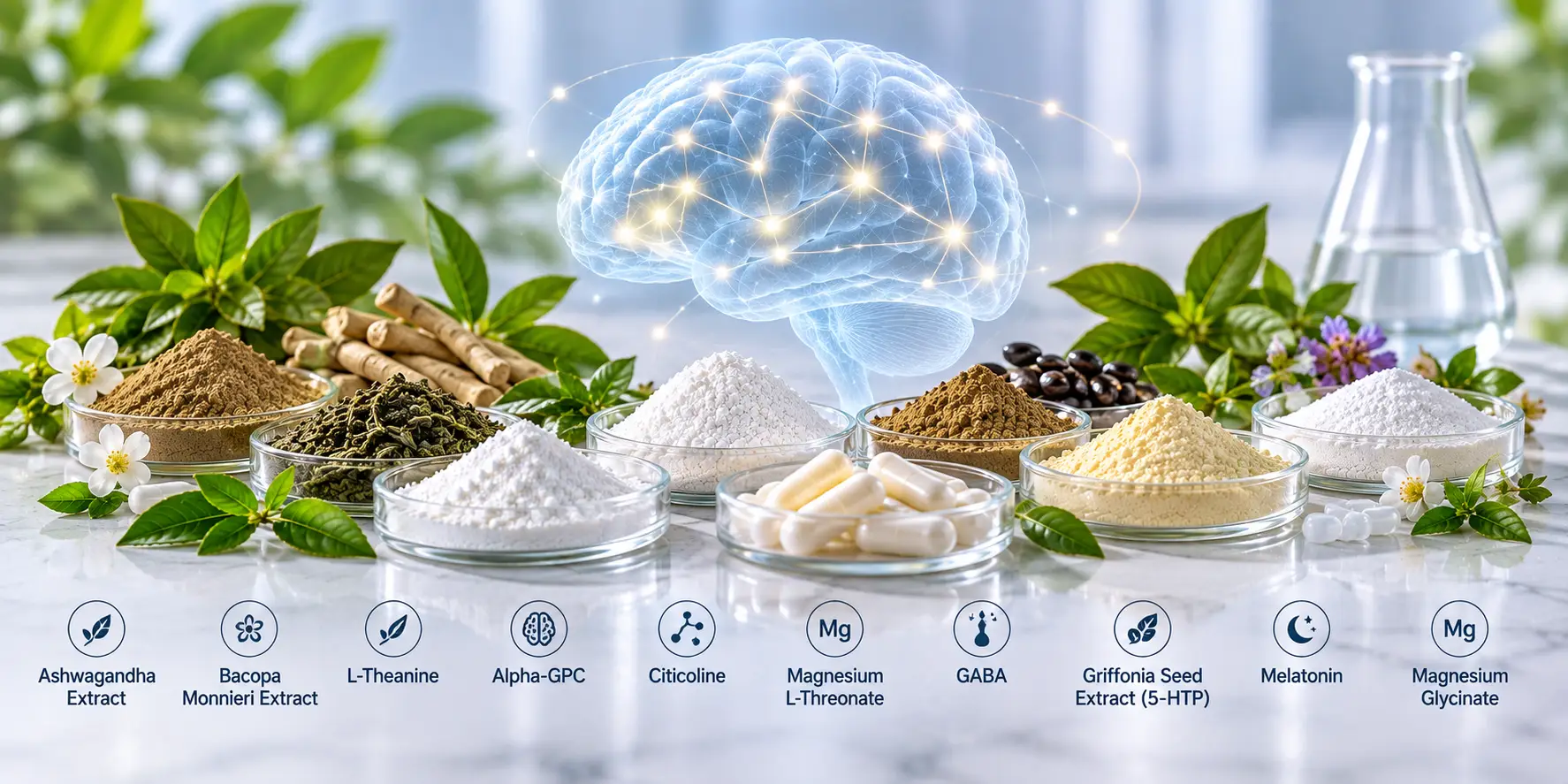
Below are ten ingredients that can be considered when developing cognitive health, nootropic, focus, relaxation and sleep-support formulations.
1. Magnesium L-Threonate
CAS No.: 778571-57-6
Specification: 98%
Magnesium L-threonate is a specialized magnesium compound that has attracted considerable interest in the cognitive-health market.
Magnesium itself is an essential mineral involved in numerous physiological processes, including normal nervous-system function. Magnesium L-threonate has become particularly associated with formulations targeting memory, learning and overall cognitive wellness.
Recent randomized clinical research has also investigated magnesium L-threonate in relation to cognitive performance, working memory and sleep-related outcomes, although results should be interpreted in the context of the specific populations and formulations studied. Frontiers
Common formulation areas:
Memory support · Cognitive health · Healthy aging · Sleep & relaxation formulas
2. Citicoline
CAS No.: 987-78-0
Specification: 99%
Citicoline, also known as CDP-Choline (Cytidine Diphosphate Choline), is a choline-containing compound widely used in cognitive-health and brain-support formulations.
Choline contributes to normal physiological functions and is a precursor involved in acetylcholine and phospholipid metabolism. Because of these characteristics, citicoline is frequently considered for products positioned around mental performance, attention and brain health.
Clinical research on citicoline spans different populations and applications, and the evidence for cognitive enhancement is not uniform across populations. A 2026 systematic review in populations with mental disorders, for example, found heterogeneous results and did not support treating citicoline as an established cognitive-enhancing therapy in those populations. PubMed
Common formulation areas:
Focus · Mental performance · Brain health · Nootropic formulations
3. Bacopa Monnieri Extract
Botanical Name: Bacopa monnieri
Specification: 20% Bacosides by HPLC / 50% by UV
Bacopa monnieri, commonly known as Brahmi, is a botanical traditionally used in Ayurvedic practices and is now one of the better-known botanical ingredients in cognitive-support supplements.
Standardized Bacopa extracts are generally characterized by their bacoside content, making extract specification and analytical method particularly important when selecting raw materials.
Human studies have investigated Bacopa in areas such as memory and attention. Earlier systematic reviews found evidence suggesting potential benefits particularly in memory recall, while also noting limitations and differences among studies. PubMed
Common formulation areas:
Memory · Learning · Focus · Botanical nootropic formulas
4. L-Theanine
CAS No.: 3081-61-6
Specification: 99%
L-Theanine is a naturally occurring amino acid most closely associated with tea leaves.
It is widely used in formulations designed around relaxed focus, making it particularly interesting for products that seek to support mental performance without positioning themselves solely as stimulants.
Human research has examined L-theanine in relation to attention and psychomotor performance, including placebo-controlled studies evaluating different dosages. PubMed
It is also frequently combined with other cognitive-support ingredients in focus and productivity formulations.
Common formulation areas:
Relaxation · Focus · Stress-support formulations · Nootropic blends
5. Alpha-GPC
Chemical Name: Choline Glycerophosphate / Alpha-Glycerylphosphorylcholine
CAS No.: 28319-77-9
Specifications: 50%, 99%
Alpha-GPC is a choline-containing ingredient commonly used in sports nutrition and cognitive-support formulations.
As a source of choline, Alpha-GPC is frequently incorporated into products positioned around mental performance, concentration and neurological nutrition.
Two common commercial specifications are available:
50% Alpha-GPC – often supplied in a stabilized carrier system
99% Alpha-GPC – high-purity material for specialized formulations
This makes Alpha-GPC suitable for different dosage forms and formulation requirements.
Common formulation areas:
Focus · Mental performance · Choline supplementation · Nootropic products
6. GABA
Chemical Name: Gamma-Aminobutyric Acid / 4-Aminobutyric Acid
CAS No.: 56-12-2
Specification: 98%
GABA is a naturally occurring amino-acid-related compound and an important inhibitory neurotransmitter in the human nervous system.
As a dietary supplement ingredient, GABA is commonly found in products positioned around relaxation, stress management and sleep support.
For cognitive-health product development, this makes GABA especially relevant to formulations designed around the connection between relaxation, restorative sleep and daytime mental performance.
Common formulation areas:
Relaxation · Sleep support · Stress management · Evening formulas
7. Griffonia Seed Extract (5-HTP)
Botanical Source: Griffonia simplicifolia
Active Ingredient: 5-Hydroxytryptophan (5-HTP)
CAS No.: 56-69-9
Specification: 98% 5-HTP
Griffonia simplicifolia seeds are a natural commercial source of 5-Hydroxytryptophan (5-HTP).
5-HTP is an intermediate in serotonin biosynthesis and is therefore generally positioned differently from direct focus-oriented ingredients such as citicoline or Alpha-GPC.
Within broader cognitive-wellness product concepts, Griffonia seed extract is more commonly considered for formulations associated with mood, relaxation and sleep-related wellness.
Common formulation areas:
Mood support · Relaxation · Sleep-support formulations · Wellness blends
8. Melatonin
CAS No.: 73-31-4
Specification: 98%
Melatonin is naturally associated with regulation of the body’s sleep-wake cycle.
Although it is not primarily a conventional cognitive-performance ingredient, sleep is closely connected with many aspects of daytime functioning. For this reason, melatonin is relevant to the broader sleep–recovery–cognitive wellness category.
In ingredient portfolios, it is generally better positioned as a specialized sleep-support ingredient rather than as a direct memory or focus enhancer.
Common formulation areas:
Sleep support · Circadian-rhythm formulations · Nighttime wellness products
Regulatory status and permitted uses of melatonin vary substantially by market and should be evaluated for the intended country of sale.
9. Magnesium Glycinate
CAS No.: 14783-68-7
Specification: 98%
Magnesium glycinate is a chelated form of magnesium in which magnesium is associated with the amino acid glycine.
It is commonly used in nutritional supplements where magnesium supplementation, relaxation and general wellness are the primary formulation objectives.
Within cognitive-wellness products, magnesium glycinate fits particularly well into relaxation, nighttime and stress-support concepts, rather than being positioned as a direct nootropic ingredient.
Common formulation areas:
Magnesium supplementation · Relaxation · Sleep-support blends · General wellness
10. Ashwagandha Extract
Botanical Name: Withania somnifera
Part Used: Root
Typical Standardization: Withanolides
Ashwagandha is a botanical with a long history of use in Ayurveda and has become an important ingredient in modern stress-management and wellness formulations.
Unlike ingredients primarily positioned around neurotransmitter precursors or mineral nutrition, Ashwagandha is commonly incorporated into formulations targeting stress management, relaxation and overall mental wellbeing.
For cognitive-health product development, it can therefore complement ingredients focused more directly on memory, focus or nutritional support.
Common formulation areas:
Stress management · Relaxation · Mental wellbeing · Adaptogenic formulations
Building a Multi-Ingredient Cognitive Support Formula
The cognitive-health category is broader than simply “memory enhancement.” Different ingredients can serve very different formulation purposes.
| Formulation Direction | Relevant Ingredients |
|---|---|
| Memory & Learning | Magnesium L-Threonate, Bacopa Monnieri Extract |
| Focus & Mental Performance | Citicoline, Alpha-GPC, L-Theanine |
| Relaxed Focus | L-Theanine, Ashwagandha Extract |
| Relaxation & Stress Support | GABA, Magnesium Glycinate, Ashwagandha Extract |
| Sleep & Recovery | Melatonin, GABA, Magnesium Glycinate, 5-HTP |
| Multi-Pathway Cognitive Wellness | Botanical + amino acid + mineral combinations |
Importantly, ingredients in the same category are not necessarily interchangeable. Their mechanisms, evidence base, regulatory status, recommended specifications and formulation characteristics differ substantially.
For example, standardized Bacopa extracts have been studied in randomized human trials, with systematic reviews reporting some evidence relating particularly to memory and attention, while research into other ingredients and cognitive outcomes can be more limited or population-specific.
Selecting Raw Materials for Cognitive Health Products
For manufacturers and formulators, ingredient identity alone is not enough. Raw-material selection should also consider purity, assay method, active-component standardization, stability, analytical documentation and intended finished-product format.
For botanical ingredients such as Bacopa Monnieri Extract and Ashwagandha Extract, botanical identity, plant part and active-compound standardization are particularly important. For compounds such as Citicoline, L-Theanine, Alpha-GPC and magnesium ingredients, purity and analytical specifications become key considerations.
This allows manufacturers to develop cognitive-support products with clearly defined ingredient specifications and consistent quality.
Cognitive Health Ingredients from ProMaxBio
ProMaxBio supplies botanical extracts and functional ingredients for dietary supplements, functional nutrition and related product development.
Our cognitive-health ingredient portfolio includes:
Magnesium L-Threonate · Citicoline · Bacopa Monnieri Extract · L-Theanine · Alpha-GPC · GABA · Griffonia Seed Extract (5-HTP) · Melatonin · Magnesium Glycinate · Ashwagandha Extract
Specifications and documentation can be provided according to individual product requirements.
Looking for ingredients for your next cognitive health formulation? Contact ProMaxBio for specifications, samples and quotation information.