
PDRN Cosmetic Ingredients: What Buyers Should Verify Before Sourcing

PDRN Cosmetic Ingredients has become a visible term in cosmetic ingredient sourcing, but a familiar name is not a complete specification. Buyers developing topical skincare should establish what the supplied material contains, how it is characterized, and whether its evidence applies to the intended formula. A clear technical review is more useful than treating every PDRN offering as equivalent.
Clarify Identity and Compositio
PDRN stands for polydeoxyribonucleotide and refers to DNA-derived material. Commercial descriptions may use related terms, including polynucleotides, Sodium DNA, or Hydrolyzed DNA. Ask the supplier to explain the exact identity, appropriate cosmetic ingredient declaration, and complete composition.
A powder, preserved solution, and encapsulated preparation are different purchasing formats. Request disclosure of water, carriers, preservatives, and other ingredients where applicable. A name on a product sheet does not establish fragment size, active content, or equivalence to a material tested in published research.
Confirm Source and Traceability
Request the biological source, production route, and lot traceability documents. Where a marine source is claimed, ask for the species and relevant origin information. Alternative-source or animal-free claims require their own supporting evidence.
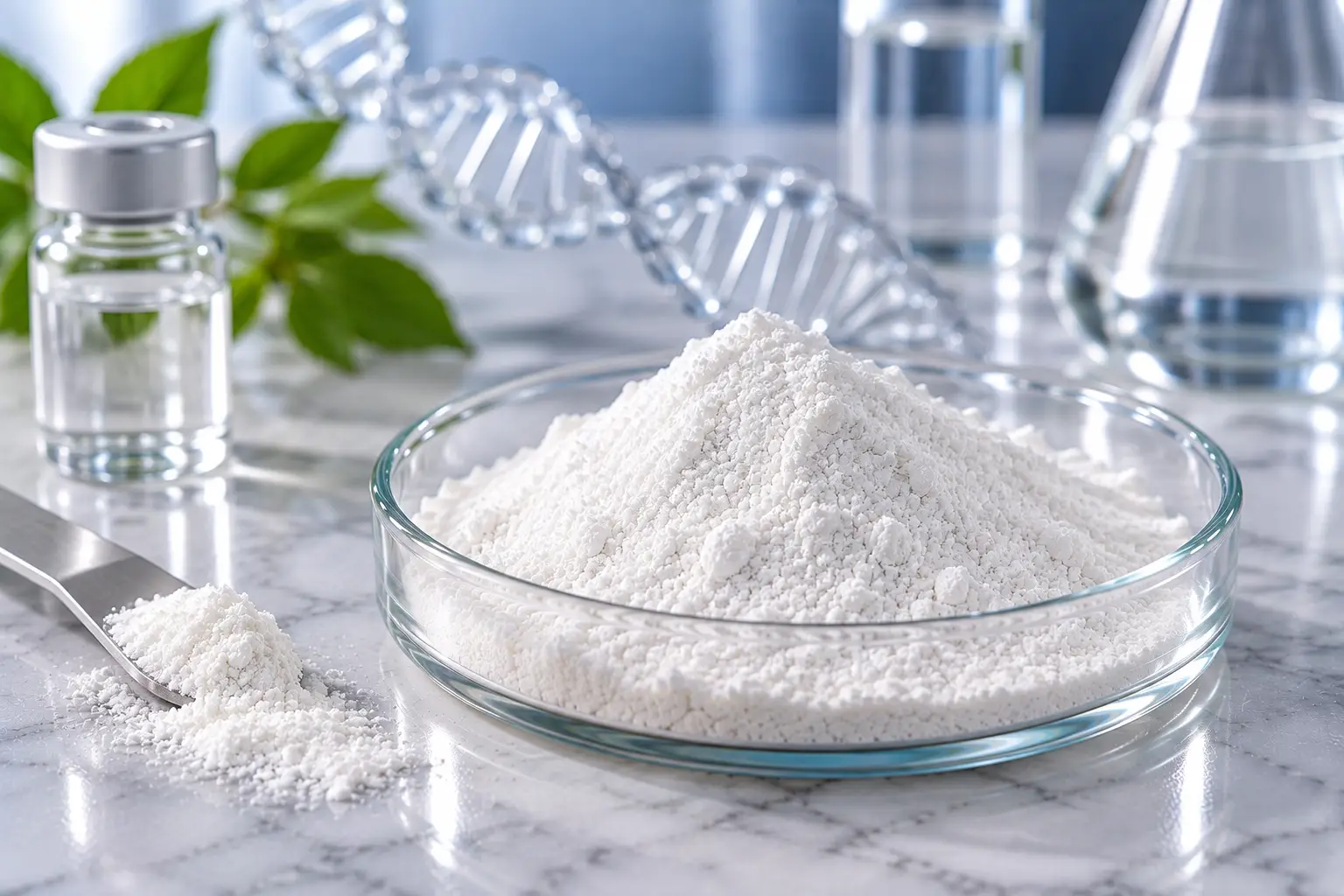
Do not infer source from a marketing image or powder appearance. Discuss relevant residual-protein and impurity controls with the supplier, and review allergen-related information appropriate to the source and intended market. Source documentation should match the exact grade proposed for purchase.
Define the Assay and Molecular-Size Profile
Ask what a quoted purity percentage measures and which analytical method supports it. Clarify whether the value describes DNA content, a particular fraction, or another defined quantity. Units, reporting basis, and moisture corrections should be stated.
Request fragment-length or molecular-weight information where relevant, including the method and distribution rather than only a single marketing label. “Low molecular weight” should be supported by a numerical specification. The same headline purity does not demonstrate identical material characteristics.
Keep Topical and Medical Evidence Separate
Published PDRN studies include laboratory experiments and medical applications using different administration routes. An injection study does not establish the performance of an ordinary topical serum. Likewise, findings from cultured cells should not be presented as proven clinical benefits for a finished cosmetic.
Review the tested material, delivery system, concentration, comparator, and measured outcome. Research has explored delivery modifications for topical applications, illustrating that formulation matters. It does not establish that an uncharacterized powder or any product carrying the PDRN name will behave the same way.
Test the Actual Cosmetic Formula
Request grade-specific guidance on incorporation, pH, temperature, and storage. Assess compatibility with your preservatives, electrolytes, polymers, and other ingredients using representative samples.
Check appearance, odor, dispersion, viscosity, and stability over the intended shelf life. If the ingredient is supplied as an encapsulated system, request its composition and relevant characterization. Raw-material microbiological results do not replace appropriate preservation testing and safety evaluation of the finished cosmetic.
Build a Product-Specific Quality Checklist
A practical qualification review should include:
- Exact identity, ingredient declaration, and composition.
- Source and production-route documentation.
- Defined assay and analytical method.
- Available molecular-size or fragment-length information.
- Relevant microbiological and impurity limits.
- Batch-specific COA, storage, and shelf-life support.
Verify any certification against the facility, covered activities, issuer, and validity. A generic quality-system statement does not replace batch testing. A cosmetic raw material should not be assumed suitable for injection or another medical use.
Prepare a Clear Sourcing Brief
Before requesting quotations, define the intended topical application, material format, target active contribution, packaging, and destination market. Compare prices for equivalent compositions and documentation scopes.
Where a prepared solution contains only a fraction of active material, calculate its contribution to the finished formula using the verified assay. Treat this as a formulation calculation, not evidence of efficacy. Confirm ingredient eligibility and proposed claims for the target market before production.
Discuss Your Requirements with ProMaxBio
Contact ProMaxBio with your PDRN sourcing brief and request current specifications for the proposed grade. Confirm availability, supporting documents, and sample evaluation requirements before ordering. For another cosmetic specification guide, read our saccharide isomerate overview.
Research references: Experimental study of modified PDRN for topical delivery; randomized study of postoperative PDRN injections.