

Vitamin K2 MK-4 vs. MK-7: Specifications and Sourcing Considerations

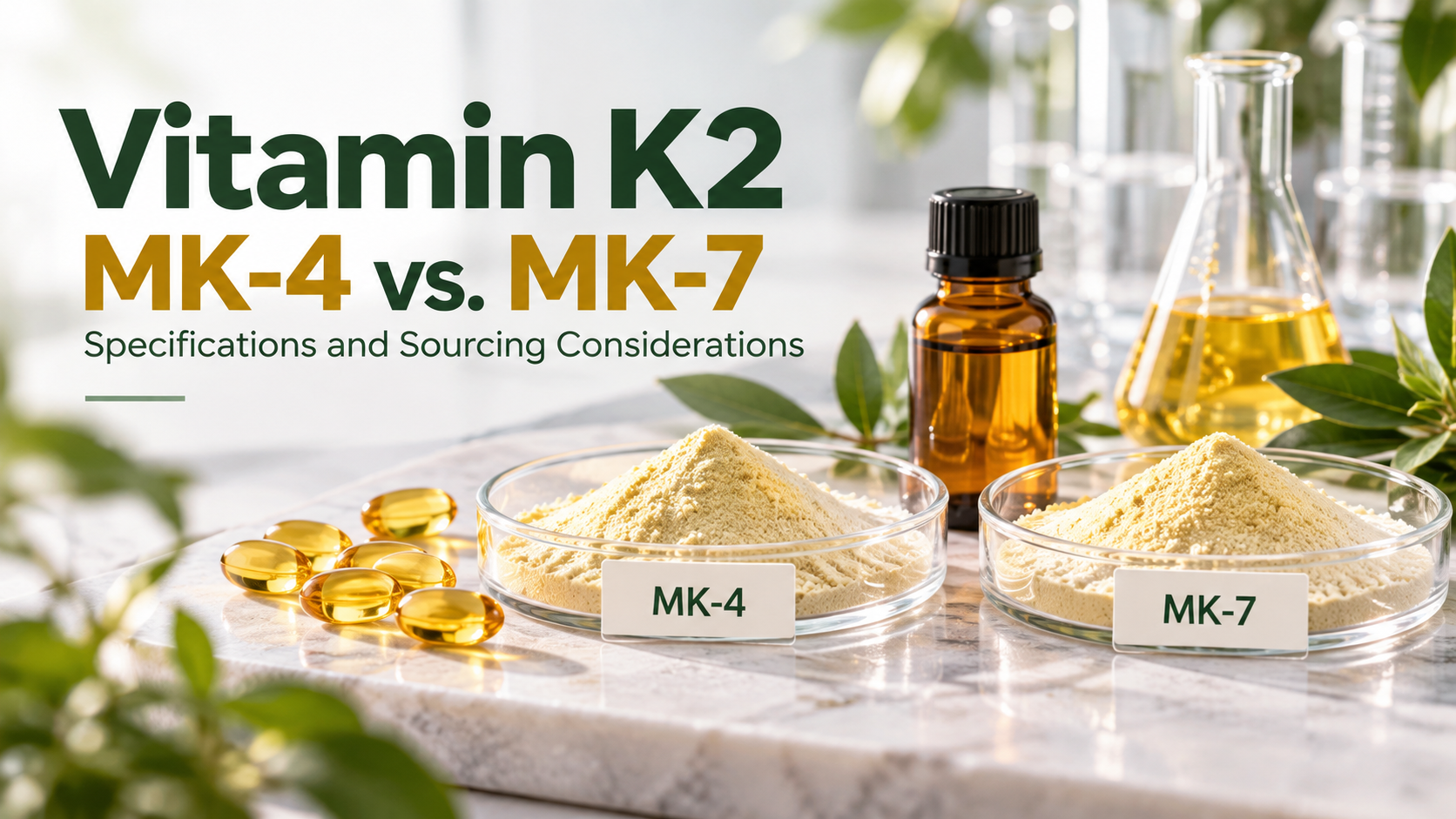
Vitamin K2 MK-4 vs. MK-7. Vitamin K2 ingredients are offered in several forms, with menaquinone-4 (MK-4) and menaquinone-7 (MK-7) among the most familiar. For supplement buyers, choosing between them requires more than comparing a purity percentage. Chemical identity, delivery format, assay method, stability, and the evidence supporting a proposed product all deserve attention.
What Distinguishes Vitamin K2 MK-4 from MK-7?
MK-4 and MK-7 are members of the menaquinone family. The numbers indicate the number of isoprene units in their side chains; they do not represent a quality ranking or potency multiplier. Both are forms of vitamin K2, but their structures and behavior differ.
Ask suppliers to identify the exact form and production route. MK-7 may be produced through fermentation or synthesis. Source labels alone do not establish superior performance: a human crossover study found the specific synthetic MK-7 tested to be bioequivalent to the fermentation-derived comparator.
Interpret Bioavailability Evidence Carefully
Research comparing nutritional amounts in healthy young women found a more sustained measurable serum response to MK-7 than to Vitamin K2 MK-4 under the tested conditions. This helps explain interest in MK-7, but the small study should not be interpreted as proving that Vitamin K2 MK-4 is ineffective or that MK-7 always produces better clinical outcomes.
When reviewing bone or cardiovascular research, check the form, dose, population, duration, and endpoint. Changes in vitamin K-dependent biomarkers are not equivalent to demonstrated reductions in fractures or cardiovascular events. Evidence should match the intended product and claim.
Separate Active Content from Raw-Material Purity
A high-purity concentrate and a diluted powder preparation are different purchasing formats. Request the actual Vitamin K2 MK-4 or Vitamin K2 MK-7 content in the supplied ingredient, along with a complete declaration of carriers, oils, stabilizers, or encapsulation materials.
For illustration, 0.2% active content equals 2,000 ppm, or 2 mg per gram. At that verified concentration, 50 mg of ingredient contributes 100 micrograms of active vitamin. This is a formulation calculation, not a recommended dose. Apply the actual batch assay and confirm the basis of reporting.
Review MK-7 Isomer Specifications
MK-7 quality documentation should distinguish total reported content from the all-trans component. Ask whether the analytical method separates relevant cis/trans isomers and related compounds, and how the all-trans specification is expressed.
A statement such as “98% all-trans” requires a clear denominator: it could describe the proportion within the MK-7 fraction rather than 98% active MK-7 in the whole carrier preparation. Request suitable chromatographic evidence where needed. Do not infer an isomer profile from the source or powder appearance.
Confirm Stability in the Intended Formula
Published MK-7 formulation research shows that stability can depend on the ingredient preparation and its interaction with other components. A raw-material shelf-life claim should therefore not automatically be transferred to a finished tablet, capsule, or powder blend.
Request grade-specific guidance for storage, packaging, and processing. Evaluate compatibility with calcium, magnesium, and other ingredients when developing combination products. Confirm retained active content during appropriate finished-product stability studies rather than assuming the starting assay remains unchanged.
Build a Practical Supplier Checklist
Before ordering, review:
- Exact identity: Vitamin K2 MK-4 or Vitamin K2 MK-7, source, and production route.
- Active content, units, reporting basis, and test method.
- MK-7 isomer profile and relevant impurity limits.
- Carrier composition and applicable allergen declarations.
- Batch-specific COA, traceability, storage, and shelf-life support.
Confirm eligibility and labeling for the destination market. Vitamin K can interact importantly with warfarin and related anticoagulants; appropriate consumer information should be addressed during product development. Verify any supplier certification separately from product-specific testing.
Discuss Your Vitamin K2 Requirements with ProMaxBio
Contact ProMaxBio with your preferred form, target active content, delivery format, and intended market to discuss sourcing requirements. Request current technical documents for the proposed grade and confirm availability before ordering. For customized finished products, explore our OEM and private-label services.
References: NIH vitamin K fact sheet; MK-4 and MK-7 bioavailability study; MK-7 formulation stability study; synthetic and fermentation-derived MK-7 comparison.