
Glabridin (Purity ≥40.0%-98.0% HPLC / Water-Soluble CWS & Lipophilic / Glycyrrhiza glabra) | The “Whitening Gold” Phyto-Active for Tyrosinase Inhibition, Post-Inflammatory Erythema & Radiance
1. Product Overview & Value Proposition
Glabridin ((3R)-3-(2,4-dihydroxyphenyl)-8,8-dimethyl-3,4-dihydro-2H-pyrano[2,3-f]chromene, 光甘草定), a specialized prenylated isoflavane isolated strictly from the root systems of Glycyrrhiza glabra L. (Smooth Licorice), is internationally celebrated in clinical cosmeceuticals and aesthetic dermatology as “Whitening Gold” (美白黄金). Due to its scarce natural abundance—constituting merely 0.1% to 0.3% of the dry weight of wild *G. glabra* roots—and its demanding extraction economics, Glabridin stands as one of the most precious and effective plant-derived skin-brightening actives in modern cosmetic chemistry. Unlike ordinary licorice extracts derived from *Glycyrrhiza uralensis* (Chinese licorice, which concentrates glycyrrhizin but is completely devoid of glabridin), authentic *G. glabra* yields an isoflavane scaffold engineered by nature to deliver multi-targeted melanogenesis suppression alongside clinical anti-inflammatory relief.
In human melanogenesis biochemistry, Glabridin acts as a non-cytotoxic, reversible competitive inhibitor of the rate-limiting enzyme tyrosinase, blocking both its monophenolase (tyrosine to L-DOPA) and diphenolase (L-DOPA to dopaquinone) catalytic activities. Pharmacological comparative evaluations demonstrate that Glabridin’s tyrosinase inhibitory potency (IC50 ~0.43 μg/mL) is approximately 16 times higher than hydroquinone, 230 times higher than kojic acid, and more than 1,000 times higher than synthetic arbutin—all without triggering permanent melanocyte toxicity, rebound hyperpigmentation, or cytotoxic vitiligo. Furthermore, Glabridin downregulates dopachrome tautomerase (TRP-2) and suppresses the enzymatic activation of cyclooxygenase-2 (COX-2) and nuclear factor kappa B (NF-κB) following solar ultraviolet (UVB) exposure, calming post-inflammatory erythema (PIE), soothing facial flushing, and accelerating the clearance of stubborn post-inflammatory hyperpigmentation (PIH). To satisfy diverse luxury formulation profiles, we provide specialized commercial grades:
- Glabridin 40% Standard Cosmetic Grade: The industry-benchmark lipophilic active powder, dissolved effortlessly in cosmetic glycols and natural emollients for high-potency dark spot treatments and anti-aging night creams.
- Ultra-Pure Clinical Grade (≥ 90.0%–98.0% HPLC): Pure off-white to snow-white microcrystalline powder stripped of licorice resin polymers, designed for luxury serums, hypoallergenic formulations, and high-clarity prestige emulsions.
- Cold-Water-Soluble (CWS) Microencapsulated / Nano-Liposomal Grades (4%–10%): Bypasses native hydrophobic insolubility through supramolecular cyclodextrin complexation and liposomal phospholipid entrapment, yielding 100% crystal-clear aqueous dissolution in facial toners, essence waters, and post-procedure sheet masks without precipitation.
- Broad-Spectrum Dermato-Protective Complex: Concurrently scavenges free radicals, halts squalene and cell membrane lipid peroxidation, and accelerates structural barrier recovery in sensitive and rosacea-prone skin types.
As an established bulk Glabridin manufacturer and direct botanical active supplier, we source authentic *Glycyrrhiza glabra* roots harvested from certified regional plantations in Xinjiang and Central Asian arid basins. Our processing lines utilize selective continuous counter-current solvent extraction, multi-stage macroporous resin chromatography, and molecular crystallization. To empower agile skincare brands, formulators, and contract manufacturing organizations (CMOs), we pair uncompromising analytical quality with flexible commercial terms: accessible low MOQ procurement for benchtop pilot trials, multi-ingredient shipment consolidation across our cosmetic bioactives (Bakuchiol, Ectoine, L-Ergothioneine, PDRN, Ferulic Acid), and dedicated on-the-ground China-wide raw material sourcing assistance tailored to your exact manufacturing requirements.
2. Product Specifications (Analytical Quality)
| Test Item | Standard Cosmetic Grade (Glabridin 40%) | Prestige Grade (Glabridin ≥90%) | Ultra-Pure Grade (Glabridin ≥98%) | Test Method |
|---|---|---|---|---|
| Botanical Identification | Conforms to authentic Glycyrrhiza glabra Chromatographic Fingerprint (HPLC) | HPLC-DAD / HPTLC / DNA Barcoding | ||
| Glabridin Assay (on Dry Basis) | ≥ 40.00% (HPLC-UV) | ≥ 90.00% | ≥ 98.00% (Clinical Target) | HPLC-UV (at 282 nm) |
| Glycyrrhiza uralensis Substitution | Negative / Absent (Zero non-glabra marker contamination) | HPLC-DAD Fingerprint Verification | ||
| Melting Point Range | 148.0°C – 154.0°C | 152.0°C – 156.0°C | 154.0°C – 157.0°C | Capillary Melting Apparatus |
| Glycyrrhizinic Acid Content | ≤ 1.00% | ≤ 0.20% | ≤ 0.05% / Non-detectable | HPLC-UV |
| Appearance & Color | Light brownish-yellow to amber-brown powder | Off-white to pale cream fine powder | Pure white microcrystalline powder | Visual / Organoleptic |
| Odor & Sensory Fingerprint | Characteristic faint sweet, woody-licorice aroma; neutral, clean taste | Organoleptic | ||
| Solubility Profile | Soluble in ethanol, butylene glycol, propanediol, and cosmetic esters; insoluble in water | USP <641> | ||
| Water-Soluble CWS Grade Option | Available as 4%–10% CWS Powder (100% clear dissolution in cold water; NTU < 2.5) | Visual / Turbidimetry | ||
| Particle Size | 100% passing 80 mesh (Ultra-fine 100 mesh available for cold solubilization) | Sieve Analysis | ||
| Loss on Drying / Moisture | ≤ 3.00% | ≤ 1.00% | USP <731> (105°C) | |
| Total Ash / Residue on Ignition | ≤ 2.00% | ≤ 0.20% | USP <281> (600°C) | |
| Heavy Metals (Pb) | < 1.0 ppm (As < 1.0 ppm, Cd < 0.5 ppm, Hg < 0.1 ppm; Prop 65 compliant) | ICP-MS | ||
| Residual Solvents (Ethanol, Ethyl Acetate) | ≤ 3,000 ppm Ethanol; ≤ 1,000 ppm Ethyl Acetate (Zero toxic solvents) | GC-HS | ||
| Microbiological Limits | Total Aerobic Microbial Count ≤ 100 CFU/g; Yeast & Mold ≤ 10 CFU/g; Pathogens Absent | USP/EP Standard | ||
3. Functional Applications (Mechanism of Action)
Deploying pharmaceutical-grade Glabridin across clinical brightening serums, post-laser recovery creams, and sensitive-skin barrier formulations provides scientifically validated biological mechanisms:
- Dual-Stage Catalytic Inhibition of Tyrosinase: Glabridin binds directly to the active catalytic binuclear copper center of tyrosinase, reversibly blocking both monophenolase (conversion of L-tyrosine to L-DOPA) and diphenolase (oxidation of L-DOPA to dopaquinone) enzymatic activities. Clinical comparative bioassays confirm that Glabridin inhibits tyrosinase activity over 16 times more potently than hydroquinone, 230 times more potently than kojic acid, and more than 1,000 times more potently than beta-arbutin, without exerting melanocyte cytotoxicity.
- Downregulation of Melanocyte TRP-1 & TRP-2 Enzymes: Beyond tyrosinase inhibition, Glabridin downregulates the transcription and catalytic activity of tyrosinase-related protein-1 (TRP-1) and dopachrome tautomerase (TRP-2). This prevents the secondary polymerization of dopachrome into dark, insoluble eumelanin, ensuring a comprehensive, multi-point enzymatic blockade of melanin synthesis.
- COX-2 / PGE2 Suppression & Anti-Erythema Relief: Solar ultraviolet (UVB) radiation triggers membrane phospholipase A2 to liberate arachidonic acid, driving cyclooxygenase-2 (COX-2) to produce pro-inflammatory prostaglandin E2 (PGE2) and leukotriene B4 (LTB4). Glabridin strongly inhibits COX-2 expression, suppressing cutaneous microvascular dilation, preventing UVB-induced sunburn erythema, and accelerating the resolution of post-inflammatory erythema (PIE) in acne-prone and reactive skin.
- Potent Inhibition of Squalene & Membrane Lipid Peroxidation: The lipophilic structure of Glabridin allows it to intercalate directly into sebum and epidermal cell membranes. It scavenges singlet oxygen (¹O₂) and hydroxyl free radicals, halting squalene peroxidation. Because peroxidized squalene is a major comedogenic stimulus that triggers follicular hyperkeratosis and inflammatory acne lesions, Glabridin protects pores from inflammatory blemish initiation.
- Suppression of Endothelin-1 (ET-1) Paracrine Signaling: Keratinocytes exposed to ultraviolet rays synthesize and release endothelin-1 (ET-1), a peptide that stimulates neighboring melanocytes to expand dendritic arms and accelerate pigment production. Glabridin attenuates ET-1 expression, interrupting intercellular communication between damaged keratinocytes and active melanocytes to prevent stress-induced pigmentation.
- Photostability & Safe Twice-Daily (AM/PM) Application: Unlike hydroquinone, pure ascorbic acid, or retinoids, Glabridin is photochemically stable under ambient sunlight and artificial light. It does not photo-isomerize or generate cytotoxic photolytic fragments upon UV exposure, allowing safe, non-irritating use in morning (AM) brightening routines and evening (PM) repair formulations.
4. Formulation Combinations & Trending Market Applications
Capitalize on the expanding clinical brightening, neuro-cosmetic soothing, and clean beauty markets by formulating with our versatile Glabridin portfolio:
- The Master Clinical “Quadruple Brightening & Melanin Eraser” Serum: Our Glabridin (Ultra-Pure ≥90% or 40% Grade, 0.05%–0.1% active) + Niacinamide (≥99.5%, 3.0%–5.0%) + Tranexamic Acid (USP, 2.0%–3.0%) + Ethyl Ascorbic Acid (Lipophilic Vitamin C, 2.0%) + Ferulic Acid (≥99.0%, 0.5%). The globally recognized benchmark dermatological brightening formula: Glabridin blocks tyrosinase catalytic activity, Tranexamic Acid inhibits plasmin-induced melanocyte activation, Niacinamide prevents melanosome transfer to keratinocytes, and Vitamin C/Ferulic Acid reduce existing oxidized dopaquinone.
- The “Post-Laser & Barrier Repair” Soothing Emulsion: Our Glabridin (CWS Water-Soluble 10%, 0.5% delivering 0.05% active) + Ectoine (≥99.0%, 1.0%–2.0%) + PDRN (Sodium DNA ≥98%, 0.2%) + Madecassoside 95% (0.2%) + Ceramide Complex (NP, AP, EOP, 0.5%). A high-tolerance barrier cream engineered for sensitized, post-chemical-peel, or post-laser skin: Glabridin clears post-inflammatory erythema (PIE), Ectoine restores hydration-shell cell stability, PDRN drives nucleotide repair, and Ceramides rebuild the stratum corneum lipid matrix.
- The Daytime “Photo-Defense & Glow” Protective Fluid: Our Glabridin (0.05%) + Bakuchiol (≥99.0%, 0.5%) + L-Ergothioneine (≥99.0%, 0.1%) + Alpha-Glucosyl Hesperidin (≥85%, 0.5%) + Plant-Derived Squalane (5.0%). A photostable daytime defense serum designed to neutralize airborne PM2.5 oxidative pollution, enhance microvascular tone to eliminate skin sallowness, and boost radiance without causing photosensitivity.
- The Fast-Melt “Radiant Tone” Nutricosmetic Beverage Sachet: Our Water-Soluble Glabridin (CWS 5%, 50 mg delivering 2.5 mg active) + L-Glutathione Reduced (≥98%, 250 mg) + Hydroxytyrosol (20% Powder, 25 mg delivering 5 mg HT) + Hydrolyzed Collagen Peptides (3,000 mg) + Vitamin C (100 mg). An innovative beauty-from-within drink packet designed to downregulate tyrosinase systemically, shift melanogenesis toward light pheomelanin, and defend deep dermal matrices against photoaging.
5. Why Choose Us As Your Long-Term Active Ingredient Partner?
- Flexible Low MOQ Policy: Mitigate product launch risk. As an agile low MOQ Glabridin bulk supplier, our orders start as low as 100 g for ultra-pure clinical grades (≥90%–98%), 500 g for standard cosmetic grade (40%), and 1 kg for water-soluble CWS powders (4%–10%), scaling smoothly up to recurring multi-hundred kilogram commercial manufacturing contracts.
- 100% Authentic Glycyrrhiza glabra Sourcing: The industry is rife with cheaper *Glycyrrhiza uralensis* and *G. inflata* extracts that contain zero glabridin. We test every commercial batch using validated HPLC-DAD fingerprint mapping and DNA barcoding, certifying 100% authentic *Glycyrrhiza glabra* origin and absolute absence of adulterated licorice species.
- Multi-Product Portfolio Consolidation: Streamline your procurement by sourcing your complete clean-cosmetic active suite (Glabridin, Bakuchiol, Ectoine, L-Ergothioneine, PDRN, Ferulic Acid, Sodium Hyaluronate), longevity vitamins (L-5-MTHF-Ca, β-NMN), and botanical extracts under a single, cost-effective freight shipment to reduce customs overhead and landed freight costs.
- Value-Added China Sourcing Service: In addition to our dedicated licorice root extraction lines and chromatographic purification columns, our on-the-ground technical team audits regional GAP harvesting cooperatives in Xinjiang and Central Asian supply corridors, validates HPLC purity testing paperwork, and procures specialized functional ingredients across China tailored to your exact manufacturing roadmap.
6. Quality & Supply Chain Assurance
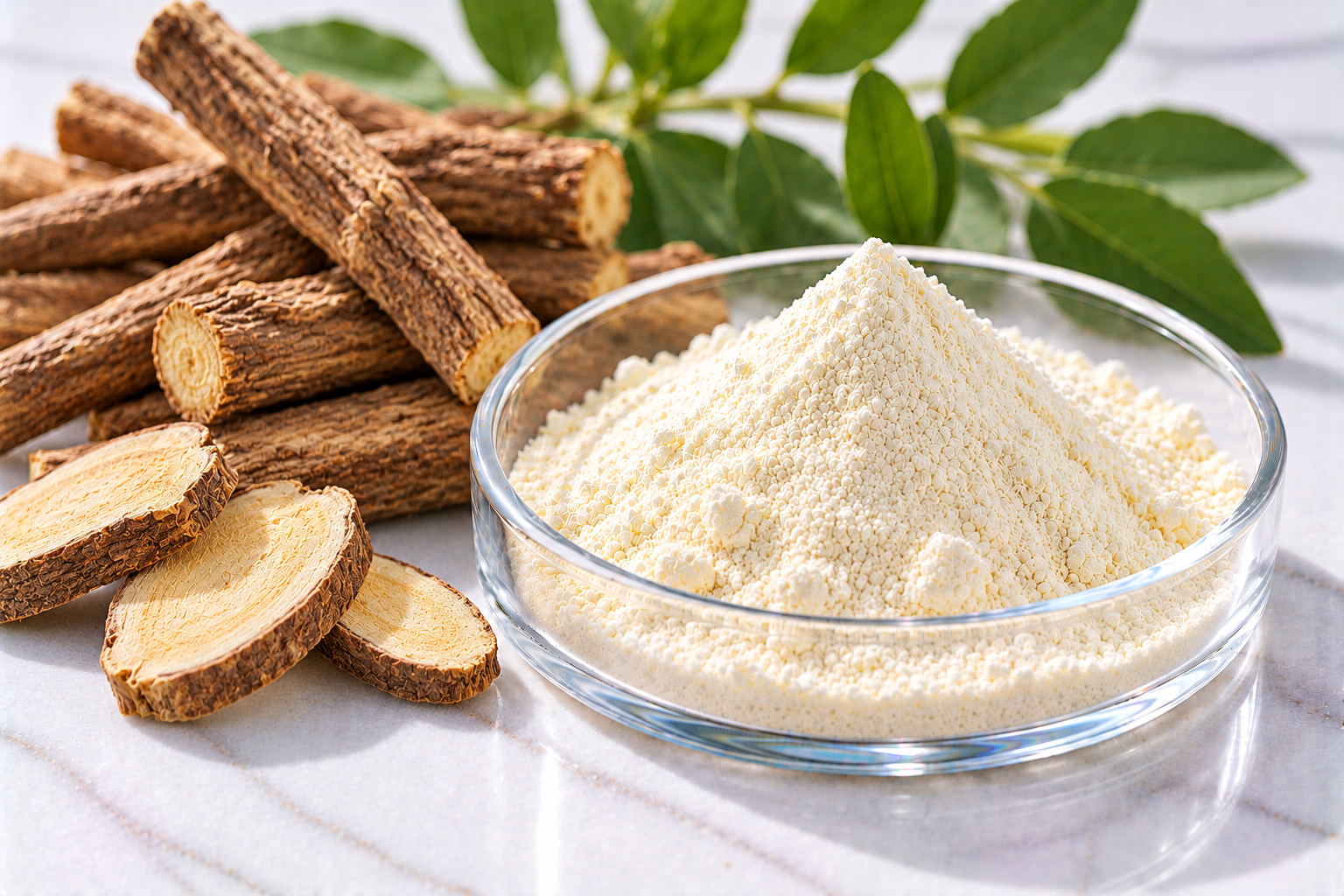
- Selective Subterranean Root Harvesting: Sourced strictly from verified 3- to 4-year-old subterranean roots and rhizomes of *Glycyrrhiza glabra*, where secondary metabolite synthesis of isoflavanes reaches its biological peak. Aerial stems and leaves are excluded to prevent chlorophyll and resin contamination.
- Clean Closed-Loop Hydro-Ethanolic Extraction: Manufactured using automated closed-loop aqueous ethanol extraction followed by continuous macroporous resin chromatographic fractionation, low-temperature vacuum concentration, and recrystallization. Completely free from hazardous petrochemical solvents (such as chloroform, hexane, or benzene) to ensure residual solvents comply with USP <467> and European Cosmetic Regulation limits.
- Validated HPLC Analytical Standardization: Every commercial batch is tested against certified primary reference standards using High-Performance Liquid Chromatography (HPLC-UV at 282 nm). We quantify pure Glabridin and secondary phenolics (glabrene, isoliquiritigenin), ensuring consistent batch-to-batch active potency and eliminating degraded polymeric impurities.
- Advanced Solubilization & Microencapsulation Technology: Native glabridin has limited water solubility, often leading to crystal precipitation in water-based cosmetics. Our microencapsulated CWS grade utilizes a modified cyclodextrin or liposomal phospholipid shell to ensure spontaneous, crystal-clear cold-water dispersion, superior stability against oxidative browning, and enhanced transdermal skin penetration.
- Comprehensive ICP-MS & Pesticide Screening: Batch-tested via high-resolution ICP-MS to ensure heavy metals (Lead, Arsenic, Cadmium, Mercury) strictly comply with California Prop 65, European Cosmetic Regulation (EC) No 1223/2009, and China Safety and Technical Standards for Cosmetics. Sealed in light-proof, nitrogen-flushed aluminum bottles (100 g, 500 g, 1 kg) and multi-layer fluorinated drums (25 kg).
7. FAQ
Q1: Why is Glabridin referred to as “Whitening Gold” in the cosmetic industry?
A1: Glabridin earned the moniker “Whitening Gold” (美白黄金) for two fundamental reasons:
- Natural Scarcity & Extraction Difficulty: Glabridin exists exclusively in one specific licorice species—Glycyrrhiza glabra—at very low concentrations (~0.1%–0.3% of dry root biomass). Extracting and refining 1 kg of 90% pure Glabridin requires approximately 500 to 1,000 kg of mature licorice roots, making its market valuation historically comparable to precious metals.
- Exceptional Whitening Potency & Safety: It is quantitatively the most potent natural tyrosinase inhibitor known, exhibiting an IC50 that is over 16 times lower than hydroquinone and 230 times lower than kojic acid, while remaining completely non-cytotoxic to melanocytes and causing zero rebound hyperpigmentation.
Q2: Can common Chinese Licorice (Glycyrrhiza uralensis) be used to extract Glabridin?
A2: No. Phytochemically, Glabridin is an isoflavane marker unique to Glycyrrhiza glabra (European / Smooth Licorice). Common Chinese licorice (Glycyrrhiza uralensis) and Xinjiang licorice (Glycyrrhiza inflata) synthesize different flavonoids (such as liquiritin, isoliquiritigenin, and licochalcone A) and triterpenoids (glycyrrhizin), but contain zero glabridin. Commercial extracts derived from non-glabra species cannot claim authentic glabridin efficacy. We certify 100% authentic *Glycyrrhiza glabra* via HPLC-DAD fingerprinting.
Q3: How do formulators dissolve lipophilic Glabridin 40% into cosmetic formulas without recrystallization?
A3: Pure Glabridin is highly lipophilic and practically insoluble in plain water. Formulators utilize three proven incorporation methods:
- Glycol Pre-Dissolution: Dissolve Glabridin 40% powder into 5%–10% cosmetic glycols (such as 1,3-butylene glycol, propanediol, or propylene glycol) at 40°C–50°C, then blend into the emulsion oil phase or cool-down phase below 45°C.
- Ester Solubilization: Readily soluble in polar cosmetic emollients (such as C12-15 alkyl benzoate, caprylic/capric triglyceride, or diisopropyl adipate).
- Water-Soluble CWS Grade: For aqueous toners, hydrogels, and clear essence waters, utilize our water-dispersible CWS or liposomal grade (4%–10% active), which dissolves instantly and transparently in room-temperature water without cloudiness or precipitation.
Q4: What is the recommended usage percentage of Glabridin in finished cosmetic formulations?
A4: Formulating guidelines depend on the active specification and target application:
- Daily Brightening Serums & Lotions: 0.05% to 0.1% of Glabridin 40% (delivering 0.02%–0.04% active glabridin; clinically proven to fade dark spots and even skin tone).
- Intensive Spot Correctors & Post-Laser Treatments: 0.1% to 0.25% of Glabridin 40% (or 0.04%–0.1% of Glabridin ≥90%).
- Aqueous Toners & Clear Sheet Masks: 0.5% to 1.0% of our water-soluble CWS 10% powder.
- Formulating Window: Optimal formulation pH is slightly acidic to neutral (pH 4.5 to 7.0); stable when added during the cool-down phase (<45°C).
Q5: What is the MOQ for bulk Glabridin orders?
A5: We support agile product commercialization with flexible minimum order quantities starting from just 100 g for ultra-pure clinical crystals (≥90%–98%), 500 g for standard cosmetic grade (40%), and 1 kg for water-soluble CWS powders (4%–10%), scaling smoothly up to recurring multi-hundred kilogram commercial manufacturing contracts.
8. References
- PubChem: Glabridin Compound Summary (CID 44256715) – National Center for Biotechnology Information.
- PubMed Central: The Inhibitory Effect of Glabridin from Licorice Extracts on Melanogenesis and Inflammation: A Comprehensive Review of Biochemical Mechanisms and Clinical Efficacy – National Institutes of Health research database.
Keywords you may search: bulk Glabridin supplier, Glycyrrhiza glabra extract manufacturer, glabridin 40 percent cosmetic powder, pure glabridin 90 98 percent HPLC, whitening gold licorice raw material, tyrosinase inhibitor cosmetic active, water soluble glabridin CWS powder, anti erythema licorice extract bulk, low MOQ cosmetic raw material provider, custom China ingredient sourcing service, pure glabridin bulk