
Astaxanthin: Specifications, Sources and Applications

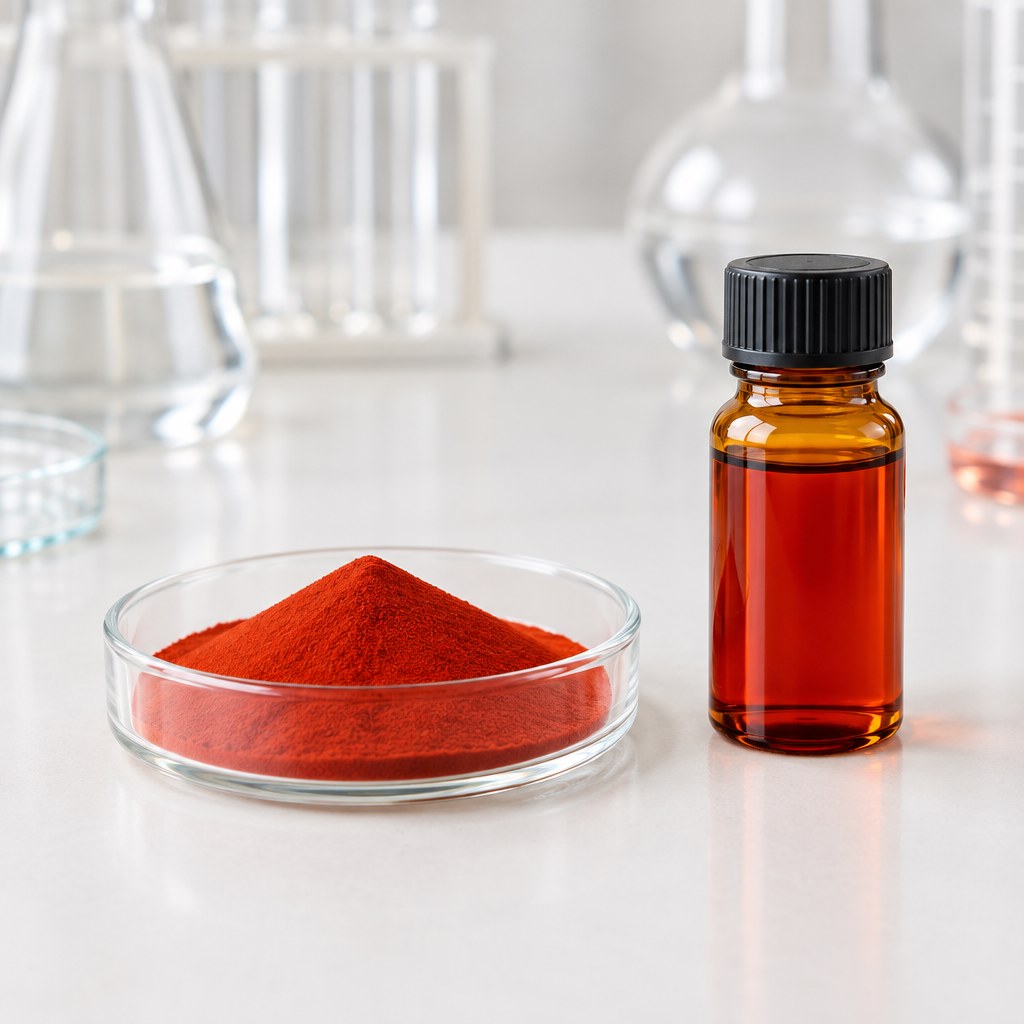
Astaxanthin is a red-orange carotenoid used in ingredient development for supplements and other applications. For buyers, choosing a suitable grade requires more than checking a concentration on a quotation. Source, analytical method, delivery format, and stability all affect how the material should be evaluated. This guide outlines practical questions to ask before purchasing.
Understand the Source
Commercial sources include the microalga Haematococcus pluvialis, certain yeasts, and chemical synthesis. These routes can produce materials with different compositions and stereoisomer profiles. Algal astaxanthin is commonly present as fatty-acid esters, while synthetic material is typically supplied in an unesterified form.
Ask the supplier to identify the organism or production route and provide supporting traceability documents. “Natural astaxanthin” is not a complete specification. Confirm the exact source and avoid assuming that results from one material apply to every other grade.
Define What the Assay Measures
A quoted percentage should identify the measured analyte and reporting basis. Clarify whether the result represents free astaxanthin, total astaxanthin expressed as free-astaxanthin equivalents, or another defined measurement. Ester content and sample preparation can affect how results are interpreted.
Request the analytical method, reference standard, and a batch-specific Certificate of Analysis (COA). Where HPLC is used, ask how sample preparation and quantification account for the material’s composition. Compare suppliers using compatible methods and reporting conventions rather than comparing percentages alone.
Choose the Right Delivery Format
Astaxanthin is fat-soluble, so its formulation behavior depends strongly on the delivery system. Ingredient offers may include oil-based preparations, dry powders, or encapsulated formats. A powder described as water-dispersible should not automatically be treated as molecularly water-soluble.
Request a full composition statement covering the carrier oil, encapsulation materials, antioxidants, and other excipients where applicable. Check whether the proposed grade suits your manufacturing process. For liquids, evaluate dispersion and settling; for capsules or tablets, assess flow and blend uniformity using a representative sample.
Plan for Stability and Packaging
Astaxanthin stability depends on its chemical form and formulation, as well as exposure conditions. Published work on astaxanthin-containing microemulsions illustrates that changes in the formulation can influence degradation. Stability should therefore be demonstrated for the actual ingredient and finished product.
Ask for storage instructions, packaging recommendations, shelf-life support, and any handling limits during production. Evaluate protection from light, oxygen, and excessive heat according to supplier guidance. Do not transfer a shelf-life claim from an unopened raw-material package to a finished product without supporting evidence.
Review Quality Documents and Batch Consistency
Agree on a written specification before placing an order. Useful review points include:
- Source identity, composition, and declared astaxanthin content.
- Assay method, units, and reporting basis.
- Relevant physical properties and microbiological limits.
- Risk-based contaminant and residual-solvent testing.
- Lot traceability, storage conditions, and retest or expiry dates.
Compare documents across several batches where possible. If a supplier claims GMP compliance, ISO certification, or another credential, verify the facility, scope, issuer, and validity. Certification documents and product-specific test results serve different purposes; neither should be treated as a substitute for the other.
Match the Ingredient to Its Intended Application
Potential applications should be evaluated against the exact grade, formulation, and destination market. A material offered for one sector should not automatically be selected for a different use. Request documentation relevant to your proposed application and confirm any applicable ingredient and labeling requirements.
Product claims also require separate evaluation. Laboratory antioxidant measurements do not, by themselves, establish a clinical outcome for a finished product. For related formulation context, read our beauty-from-within ingredient overview.
Discuss Your Specification with ProMaxBio
Contact ProMaxBio with your preferred source, target concentration, delivery format, application, and destination market to discuss sourcing requirements. Request current specifications and supporting documents for any proposed material, and confirm availability before ordering. Clear technical requirements help establish a practical starting point for sample evaluation and purchasing.
Further reading: Astaxanthin: Past, Present, and Future; Experimental study of esterified astaxanthin degradation in microemulsions.